




- Tailored to your requirements
- Deadlines from 3 hours
- Easy Refund Policy
Assuring that a company's most valuable resources are employed in a manner that is in line with and helpful to the company's overall business objectives is the primary focus of an organization's operations strategy. Nike's business and operational models are coordinated to boost productivity and advance the organization (Araujo et al., 2018). Nike's current commercial and operational model is successful because it follows its strategic Plan. The manufacturing and distribution of Nike products take up the bulk of the company's value chain. Many corporations, such as Nike, have pioneered the practice of outsourcing manufacturing.
1a) Operational processes
Nike shoes are not made in the United States of America. Shoes made by Nike account for 36% of all footwear manufactured in China and Vietnam combined. After the fabric is cut into the appropriate shapes and forms, the shoemaker sews the upper portion of the shoe together, above the sole. Workers then prepare the sole, also called stock fitting, and the connection between the upper and sole is called lasting. Afterwards, workers participate in a recovery process, during which the bottom heel is joined and moulded (Araujo et al., 2018). Treeing is the last process in which additions and finishing touches are added. At Nike, engineers and designers are urged to embrace disruption and create something new. The company provides design and supply to hundreds of factories all around the globe. Organic cotton, hemp, bamboo, and recycled plastic bottles are used, yet the corporation is not environmentally responsible. Shoes are often manufactured nowadays from synthetic rubber, plastic, and leather.
In efforts to solve the difficulties in the wholesale sector, particularly in North America, Nike has shifted its distribution strategy to focus on direct channels and 40 unique merchants out of its 30,000 retail partners (Araujo et al., 2018). Nike uses direct and indirect channels of distribution. Direct channels include subsidiaries that sell the product directly to customers and wholly owned distribution firms. Indirect channels include the use of brokers and other authorized agents. The ideal number of intermediaries in a distribution network for Nike is two. The company has direct contact with its clientele via its subsidiaries and retail outlets. There are two stages to the distribution chain when using unaffiliated distributors or authorized agents. If you want to reach more people and break into new markets, use a mix of direct and indirect routes (Burgelman, 2017). Nike is keen to increase its storefront presence because of its widespread popularity. Because of Nike's proactive approach to distribution, customers seldom have to go out of their way to purchase the brand's products. Still, certain goods are often held to a higher standard of exclusivity than others. Because of how they were created, certain products can only be sold in particular stores.
Nike has discovered that working with vendors that appreciate diversity in the workplace and share their commitment to sustainability is the most effective method to drive Nike's growth. Nike builds lasting relationships with its contract manufacturing suppliers based on trust and mutual respect to help improve the company's production practices, allowing it to serve its athletes better and the communities in which they live. For almost 15 years, we've relied on the same manufacturing companies to create more than 90% of our footwear and Nike-branded items (Burgelman, 2017). Suppliers that share Nike's commitment to environmental responsibility and who see the significance of a diverse and inclusive workforce may have contributed to the company's success, efficiency, and financial benefit. By working with suppliers that share our values, we can grow programs like Employee Engagement, Culture of Safety, and Environmental Minimum Programs, all of which contribute to strengthening their company's capabilities and values.
Leave assignment stress behind!
Delegate your nursing or tough paper to our experts. We'll personalize your sample and ensure it's ready on short notice.
Order now1b) Five-Year Plan for Nike
Nike will rely on new product releases and the Nike+ fan base to drive revenue growth in the years to come. One of Nike's primary goals is to increase its global market share in sports and leisure footwear, apparel, and equipment sales. Nike considers every customer to be an athlete. Nike's product strategy is informed by this business mission, which is to satisfy customers all around the globe (Du et al., 2016). Marketers at Nike want more brand loyalty, online purchases, and volunteer work in the community.
The primary goal is to boost sales to previous consumers by 60% using different means of promotion, such as emotional marketing and sponsorship of professional sports. Nike's long-term financial Plan involves more than just growth and profit. To that end, Nike is setting its sights on the middle of the next decade (De Silva et al., 2019). A rise in free cash flow in the low double digits (Du et al., 2016). To reward its investors, Nike plans to expand both its dividend and share repurchase programs. Nike aims to provide active individuals of all ages with products of the best possible quality. Nike may use a discount or a premium pricing strategy depending on the product. Value-based pricing is a method of setting prices that considers market dynamics and is increasingly used by businesses. Before setting a price, they do market research to determine what percentage of potential buyers are willing to pay for the product on average.
1c) Table for the 5-year Plan
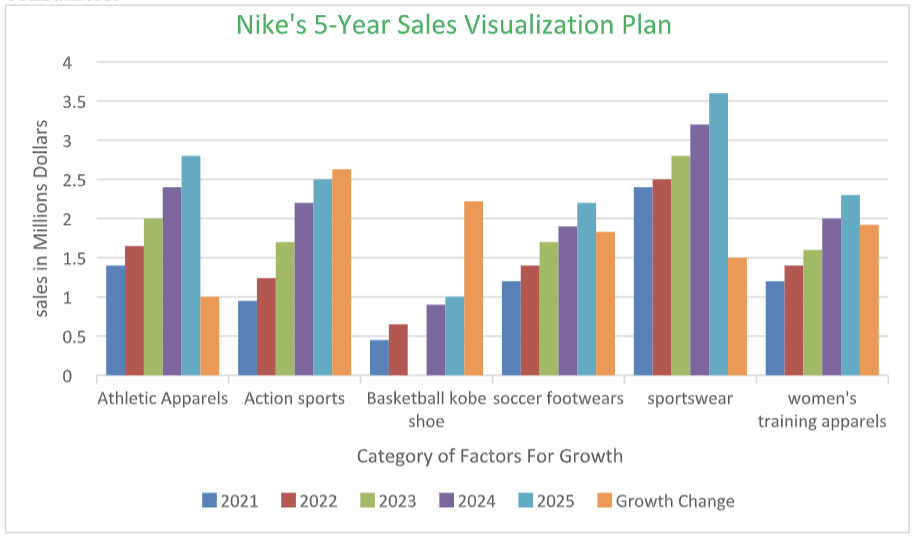
Nike's traditional catchphrases of "innovate," "inspire," and "relationships with customers" were heavily included in the company's statements. The company is concentrating on fewer things and becoming more strategic in how it allocates and uses its resources to meet its sales, customer, and financial goals. Since Covid-19 severely hit fiscal 2021's markets, fiscal 2023's forecast calls for increased sales and a higher profit margin on the Nike brand alone (De Silva et al., 2019). Below are the essential product categories that will fuel Nike's growth over the next five years.
Nike’s 5-Year Projected Sales Growth
|
Category |
2021 |
2022 |
2023 |
2024 |
2025 |
Percentage growth (change) |
|
Athletic training Apparels |
1,400,000 |
1,650,000 |
2,000,000 |
2,400,000 |
2,800,000 |
100% |
|
Action sports |
950,000 |
1,240,000 |
1,700,000 |
2,200,000 |
2,500,000 |
263% |
|
Basketball Kobe shoe |
450,000 |
650,000 |
780,000 |
900,000 |
1000,000 |
222% |
|
Soccer Footwears |
1,200,000 |
1,400,000 |
1,700,000 |
1,900,000 |
2,200,000 |
183% |
|
Sportswear |
2,400,000 |
2,500,000 |
2,800,000 |
3,200,000 |
3,600,000 |
150% |
|
Women’s training Apparels |
1,200,00 |
1,400,00 |
1,600,000 |
2,000,000 |
2,300,000 |
192% |
1d) Data Visualization
Nike wishes to keep dominating the sports apparel and shoes for athletes. The main idea is to keep growing using modern innovations, drop prices of the products for customer satisfaction, increase margins, and ensure quality products and services are offered to the consumers.
- 2) Decision Analysis
2a) TQM
Through the reduction and complete elimination of faults in the manufacturing process, TQ attempts to improve product quality, customer satisfaction, and the promotion of environmental sustainability. TQM's potential for sustained success stems from its emphasis on customers' priorities. When appropriately implemented, total quality management (TQM) may help any firm improve the quality of its services, products, and processes by mobilizing all members to work together to achieve a common goal (De Silva et al., 2019). To guarantee a constant flow of improvements, TQM combines several effective management tactics, technological tools, and persistent efforts to better the organization's overall operations.
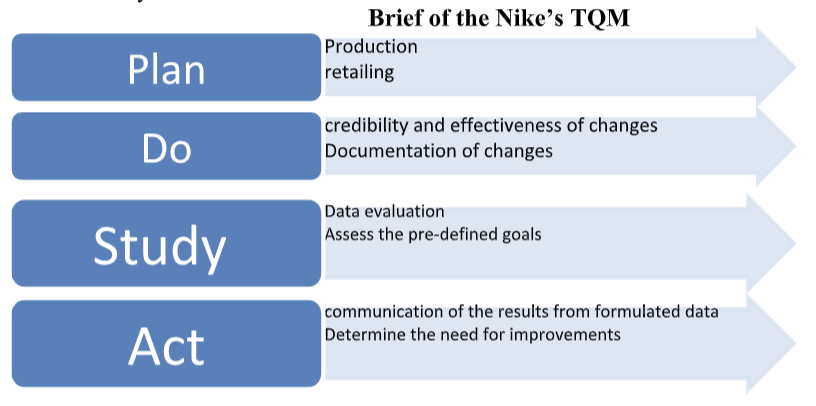
Integrating the highest standards of quality into every aspect of a business or institution's operations is a top priority nowadays. This is due in no small part to the fact that a company's bottom line and environmental impact both benefit from an emphasis on absolute excellence (Du et al., 2016). Nike, Inc. is a globally renowned leader in designing, developing, and distributing innovative and high-quality footwear, apparel, and equipment for athletes of all levels. Therefore, implementing a comprehensive quality plan may substantially improve the firm's capability to control and assure the dependability of its operations. In the context of total quality management, the word "plan" is used to define one of the initial and most crucial stages (Du et al., 2016). In this stage, the company's higher management assesses the current state of operations and changes the organization as needed. In this step, management evaluates the current state of the business, including its operations, processes, and any problems that have occurred. To identify more areas for improvement, we will be recording and evaluating all aspects of Nike's production and distribution operations (Mahdi et al., 2015).
Putting that plan into action is the second step of a TQ project. Managers are responsible for documenting the changes made to the processes at this stage. It is crucial to ensure that the changes make sense and improve the situation during this stage. Therefore, at this point, Nike's management will formally recognize and document the improvements made to operations. The third step of the TQ project is to research and analyze the data collected in the second step (Du et al., 2016). Data from Nike will be examined to see whether the defined approach is productive. In the last step, Act, there is the use of meetings and other types of communication to let everyone in the firm know how well the plan has been received thus far. Employees and other interested parties will be kept abreast of TQ plan developments and implementations so that their feedback may be included in future restatements.
Brief of Nike’s TQM
2b) Nike’s current and future trends
In the last six months, Nike has seen increased employee satisfaction from employee retention, leadership, and managers. In a survey of its employees, Nike ranked in the upper 30 per cent of companies of a similar size (based on employee ratings of corporate leadership). However, Nike's Diversity score decreased during the same period by 1%. Nike employees have always maintained a positive outlook on the organisation's future. Six of Nike's most crucial culture indicators have been positive shifts (Juntunen et al., 2019). There have been three areas where there have been rises of 1% over the last six months: retention, leadership, and manager. Nike's Diversity score has declined over the last six months, falling 1% from its beginning point.
Nike has focused on strengthening its direct sales by offering the NIKE app, a general e-commerce platform, and the SNKRS app, designed to provide customers access to highly demanded sneakers with limited availability. There was a 35% rise in Nike's online sales in the previous year, with 20% of that gain attributed to the SNKRS app. Both app downloads and income increased in 2018; this trend will likely continue in 2019 as Nike adds more limited-edition goods to the app, such as clothes. To compete with brands like Lululemon, Nike is enhancing its direct sales options (LULU). The fact that Nike has become a digital rival is encouraging for current and prospective shareholders since it demonstrates the company's ability to adapt to the business climate of the twenty-first century.
For the last three decades, Nike has pioneered the use of recycled materials in their goods to raise consumer consciousness about the need to be environmentally responsible. To that end, Nike tracks how its products affect the environment before they hit shelves. Nike's goal is to reduce its carbon footprint while simultaneously encouraging the use of environmentally friendly business practices. Nike constantly innovates new products with state-of-the-art technologies to help athletes perform better in practice and competition. The firm is committed to continuously enhancing its products, supply chain, and sustainability policies, and it has developed strong ties with some of the world's finest athletes (Juntunen et al., 2019). Nike has a vast prospective customer base because its mission statement states, "If you have a body, you are an athlete." Sustainable growth in free cash flow per share and the stock price for Nike should result from the company's youth-focused strategy and digital and global expansion.
2c) Decision Tree for Nike
The decision tree explains all the company's business processes and operational analysis to ensure customer satisfaction and that the products are readily available when the customers need them.
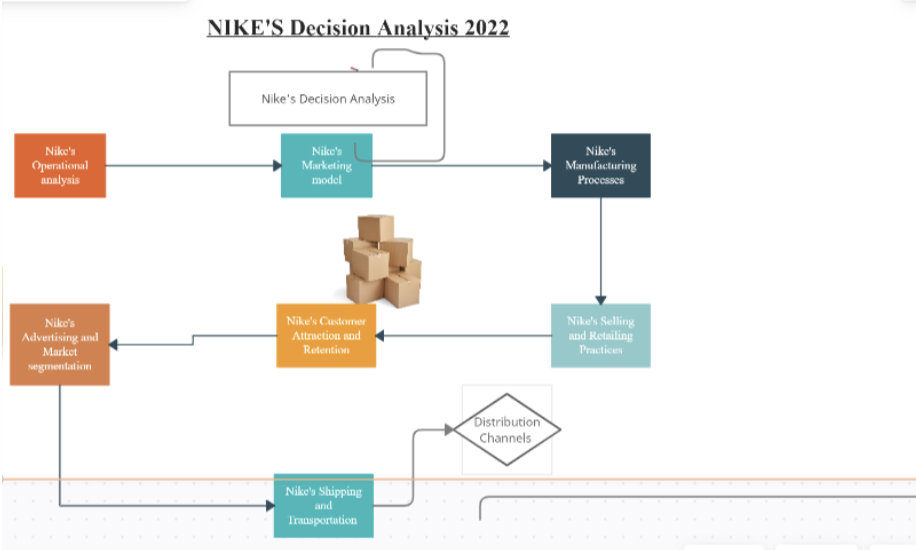
Note: Created online from: https://app.creately.com/d/0iVBqLgDrDN/edit/s/6or02nm9rm
Offload drafts to field expert
Our writers can refine your work for better clarity, flow, and higher originality in 3+ hours.
Match with writerReferences
- Araujo, D., Caldwell, H., & DeFanti, M. (2018). Nike's Utilization of Brand Strategy to Increase Global Competitiveness. In Competition Forum (Vol. 16, No. 1, pp. 109-115). American Society for Competitiveness.
- Burgelman, R. A. (2017). Complex strategic integration at Nike: Strategy process and strategy-as-practice combined. In Handbook of Middle Management Strategy Process Research. Edward Elgar Publishing. https://www.elgaronline.com/abstract/edcoll/9781783473243/9781783473243.00018.xml
- De Silva, R. K. J., Rupasinghe, T. D., & Apeagyei, P. (2019). A collaborative apparel new product development process model using virtual reality and augmented reality technologies as enablers. International Journal of Fashion Design, Technology and Education, 12(1), 1-11. https://www.tandfonline.com/doi/abs/10.1080/17543266.2018.1462858
- Du, S., Yalcinkaya, G., & Bstieler, L. (2016). Sustainability, social media-driven open innovation, and new product development performance. Journal of Product Innovation Management, 33, 55-71. https://onlinelibrary.wiley.com/doi/abs/10.1111/jpim.12334
- Juntunen, J. K., Halme, M., Korsunova, A., & Rajala, R. (2019). Strategies for integrating stakeholders into sustainability innovation: a configurational perspective. Journal of Product Innovation Management, 36(3), 331-355. https://onlinelibrary.wiley.com/doi/abs/10.1111/jpim.12481
- Mahdi, H. A. A., Abbas, M., Mazar, T. I., & George, S. (2015). A Comparative Analysis of Strategies and Business Models of Nike, Inc. and Adidas Group with special reference to Competitive Advantage in the context of a Dynamic and Competitive Environment. International Journal of Business Management and Economic Research, 6(3), 167-177. http://modir3-3.ir/article-english/isi328.pdf
