




- Tailored to your requirements
- Deadlines from 3 hours
- Easy Refund Policy
The COVID-19 accelerated the digital adoption pace by three to five years with 85% of organisations noting how they transformed into digital-first operations permanently (Paul et al., 2024). This wholesome destabilisation necessitated the creation of something new in businesses worldwide, nearly immediately, as was the case of a massive retailer adding contactless shopping to their offerings, or an age-old manufacturer adding video conferencing technology. The leadership of the digital transformation now needs not only strategic vision but also knowledge of change management and flexibility of attitude towards communication so that organisations can be in a position to cope with changes in technology and culture more effectively (Schiuma et al., 2021). The leaders are faced with difficult responsibilities of merging technology, remodeling the workforce, and expanding culture, while maintaining business continuity and competitive competence in an ever-growing digital market.
Figure 1: COVID impact on digital transformation by industry
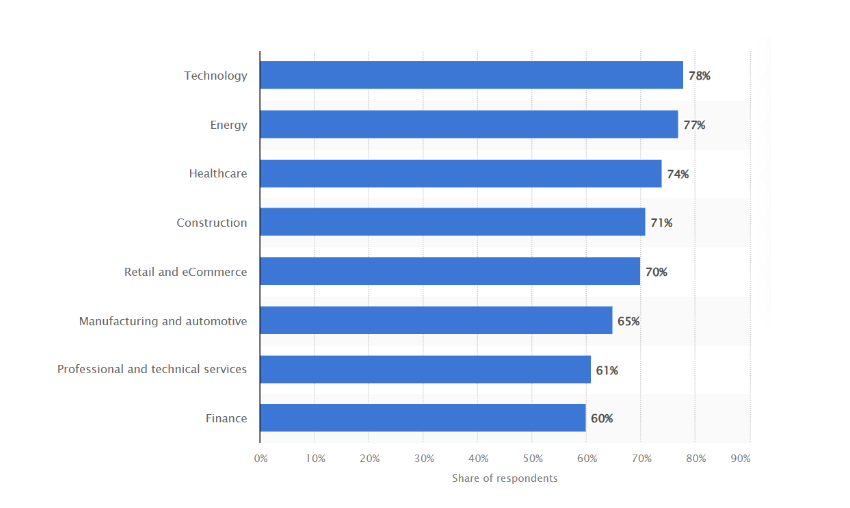
Source: Statista (2023)
The Digital Transformation Imperative
Digital transformation does not solely entail the reality that organisations are now turning more to new technologies but it is a strategy of re-imagining how organisations create value, how organisations interact with customers and how organisations operate. The forces that introduce this sense of urgency in markets are the changing customer behaviour towards online channels in an exaggerated fashion (Yadav et al., 2024), because the pace of e-commerce penetration has already accelerated by a decade in just a few months. The world is turning competitive now as online firms begin disrupting more conventional businesses, and the necessity to do so competently calls on organisations to automate their services and select their competitive gain on data analytics. Nevertheless, conventional command-and-control management frameworks tend to break down during a digital undertaking due to a lack of agility, experimental thinking, and collaborative culture to achieve technological innovation. Statistics demonstrate the acuity of this problem plainly: a study conducted by McKinsey (2022) demonstrated that 70% of digital transformation efforts are unable to meet their goals, with the majority of all failures being related to leadership and cultural issues, not to technical ones, and a significant shortage of developed managerial skills is seen.
Leave assignment stress behind!
Delegate your nursing or tough paper to our experts. We'll personalize your sample and ensure it's ready on short notice.
Order nowEssential Leadership Competencies for Digital Change
Digital transformation leaders should be strategic visionaries and digitally literate to realise new technologies such as artificial intelligence, blockchain, and Internet of Things, as well as their potential business usage outside of technical details. This competence allows leaders to foresee the principles under which the organisation will exist, where human capabilities can be expanded with the help of technology. Change management knowledge, especially the implementation of Kotters' 8-step change model in creating a state of urgency (Pollack & Pollack, 2025), coalition formation, and wait times needed to support changes in the momentum, will also be critical. Effective leaders invariably prepare for resistance management by transparently responding to issues and establishing a buy-in with all organisation members through symmetric participation and communication of the merits and expectations.
Being able to convey more responsively is a defining feature of great digital transformation leaders since they are able to work across complex technical concepts into an approachable language between different stakeholders, including board of directors and front line staff. Such leaders create an elaborate narrative of change activities that connect technological capabilities to the valuable business outcomes and personal enrichments. Moreover, data-driven decision-making will become core when leaders make decisions in a strategic manner and based on analytics instead of intuition during managerial functions, which will offer evidence-based leadership (Garcia & Adams, 2023). They build data-oriented organisational cultures by demonstrating how measures could make superior decisions, encourage experimentation with measurable outcomes, and create systems that enable data to be accessible and responsive throughout all functional departments and ranks.
Implementation Framework and Best Practices
The effective digital transformation needs a lean implementation model encompassing step-by-step plans that involve pilot projects as testing platforms to see how things work, where difficulties come in, and eventually as a strategy to be fine-tuned and rolled out on a large scale. There is a need to move to cross-functional team building, which requires siloed IT-business units to integrate by project teams, combining technical and operational skills (Zalpuri & Hamlin, 2020). Effective development plans, such as the overall up-skilling and reskilling of the workforce, keep the workforce current with digital tools and processes in line with organisational competence during changes. The performance measures set effective KPIs of transformation success to monitor the quantitative outcomes, such as efficiency gains, and qualitative measures, such as employee engagement. These beliefs are seen in the example of the cultural change at Microsoft under Satya Nadella, who transformed the company into a culture of a collaborative learner, known as learn-it-all, instead of an atmosphere of competition, known as know-it-all (Ali & Begum, 2024), using cloud-first strategies through pilot programs, cross-functional teams, comprehensive employee training, and customer satisfaction and innovation metrics over the count of traditional indicators.
Conclusion and Future Implications
The success of digital transformation depends on the leaders integrating strategic purpose, change management skills, adaptive communication, and data-driven decision-making. New directions, such as artificial intelligence and quantum computers, will require even more agility in leadership. These competencies should be solicited with dire need by current and future managers as part of continuous, unstoppable learning and practising. Finally, companies with digitally literate, flexible leaders will attain a sustainable competitive advantage in an ever-technological marketplace.
Offload drafts to field expert
Our writers can refine your work for better clarity, flow, and higher originality in 3+ hours.
Match with writerReferences
- Ali, M.M. and Begum, S. (2024). Case Study: Satya Nadella’s Leadership at Microsoft. IOSR Journal of Business and Management, [online] 26(12), pp.74–79. https://doi.org/10.9790/487X-2612027479.
- Garcia, P.A. and Adams, D.J. (2023). Data-Driven Decision Making: Leveraging Analytics and AI for Strategic Advantage. Research Studies of Business, [online] 1(02), pp.77–85. Available at: http://researchstudiesbusiness.com/index.php/Journal/article/view/9.
- McKinsey (2022). Common pitfalls in transformations: A conversation with Jon Garcia | McKinsey. [online] www.mckinsey.com. Available at: https://www.mckinsey.com/capabilities/transformation/our-insights/common-pitfalls-in-transformations-a-conversation-with-jon-garcia.
- Paul, J., Ueno, A., Dennis, C., Alamanos, E., Curtis, L., Foroudi, P., Kacprzak, A., Kunz, W.H., Liu, J., Marvi, R., Nair, S., Ozdemir, O., Pantano, E., Papadopoulos, T., Petit, O., Tyagi, S. and Wirtz, J. (2024). Digital transformation: A multidisciplinary perspective and future research agenda. International Journal of Consumer Studies, [online] 48(2). https://doi.org/10.1111/ijcs.13015.
- Pollack, J. and Pollack, R. (2025). Using Kotter’s Eight Stage Process to Manage an Organisational Change program: Presentation and Practice. Systemic Practice and Action Research, 28(1), pp.51–66. https://doi.org/10.1007/s11213-014-9317-0.
- Schiuma, G., Schettini, E., Santarsiero, F. and Carlucci, D. (2021). The transformative leadership compass: six competencies for digital transformation entrepreneurship. International Journal of Entrepreneurial Behavior & Research, [online] 28(5), pp.1273–1291. Available at: https://www.emerald.com/insight/content/doi/10.1108/ijebr-01-2021-0087/full/html.
- Zalpuri, M. and Hamlin, A.M. (2020). Building and Leading Successful Cross-Functional Teams. https://doi.org/10.1021/bk-2020-1367.ch002.
