




- Tailored to your requirements
- Deadlines from 3 hours
- Easy Refund Policy
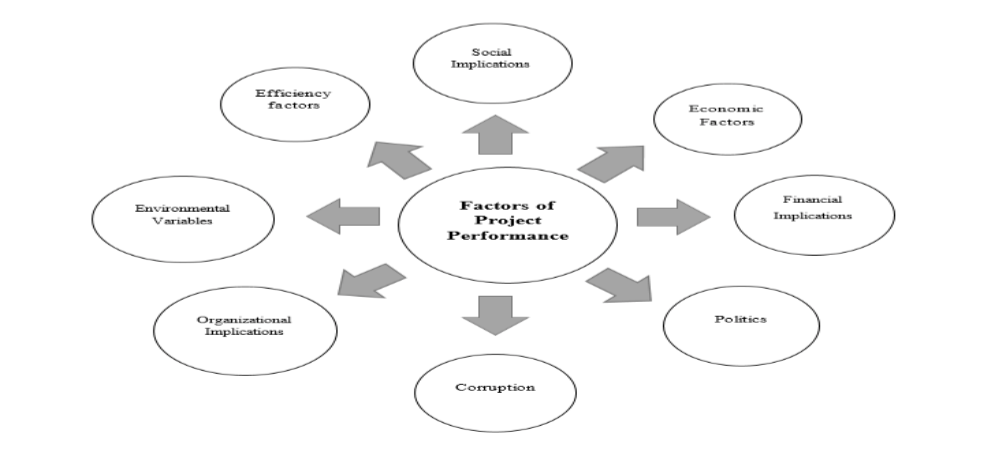
Non-developed nations have distinct business project management and implementation environments, as opposed to industrialized ones, where project management (PM) originated and developed. The majority of business projects in both countries are intricate and operate in dynamic environments. Surprisingly, the environment in which initiatives take place in less developed countries is volatile, underfunded, and unexpected. This presents challenges for project managers in developing nations, something their colleagues in wealthy economies do not face. According to Essilfie-Baiden (2019), managing projects in developing countries needs a greater degree of sensitivity than managing projects in wealthy countries since the former’s methods are more adaptable to changing conditions. Risk management, purchasing, contracts, dimensions, framework, communication between people, and information sharing are some of these procedures. As illustrated in Figure 1 below, the study provides an evaluation model that takes into account both monetary and non-monetary factors, including the more comprehensive consumer, society, environment, corruption, and political components.
Figure 1. Proposed Model of Project Management Factors in Non-Developed Countries
Source: Author Illustration.
Leave assignment stress behind!
Delegate your nursing or tough paper to our experts. We'll personalize your sample and ensure it's ready on short notice.
Order nowCritical Analysis and Evaluation
The State of Project Management in Non-Developed Countries
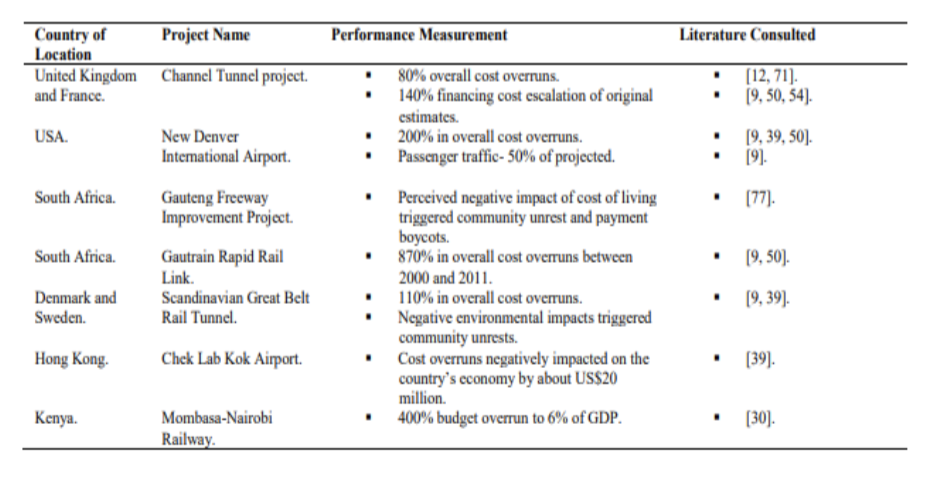
Complex initiatives in developing countries have not gone well in many different industries and geographical areas. In the construction business sector, overinflated prices and timelines are among the most common, in addition to the previously listed traits (Nyarirangwe & Babatunde, 2019). Data from Nyarirangwe and Babatunde’s (2019) study, which included 52 multi-sectoral large-scale building projects located in many countries, have supported this perspective. According to the survey, 73% and 77% of complicated projects failed to meet their original budget and schedule targets (Nyarirangwe & Babatunde, 2019). Another cross-sectoral comparative study by Nyarirangwe and Babatunde (2019) found that the most extreme schedule and cost overruns occur in hydropower construction projects. This element is primarily due to the novelty of the technology, the anticipated risks, and the safety concerns involved, as shown in Table 1 below.
Table 1. Underperformed Complex Projects in Varied Countries
Source: Nyarirangwe & Babatunde (2019, p.84).
Performance Factors of Complex Construction Projects in Developing Countries
Managing large-scale business infrastructure projects differs from more conventional ones in that they have specific features. These features, in the opinion of many researchers (Essilfie-Baiden, 2019; Nyarirangwe & Babatunde, 2019; Tereso et al., 2019), add to the difficulties in finishing large-scale building projects and, ultimately, to their stagnation. Nyarirangwe and Babatunde (2019) have cautioned against viewing large-scale construction projects as simply replications of smaller business projects, citing their size, objectives, complex structures, and organizational challenges. Rather, people should see them as singular undertakings. This opinion has been reinforced, particularly by the magnitude and centrality of the complex elements needed to accomplish these massive projects.
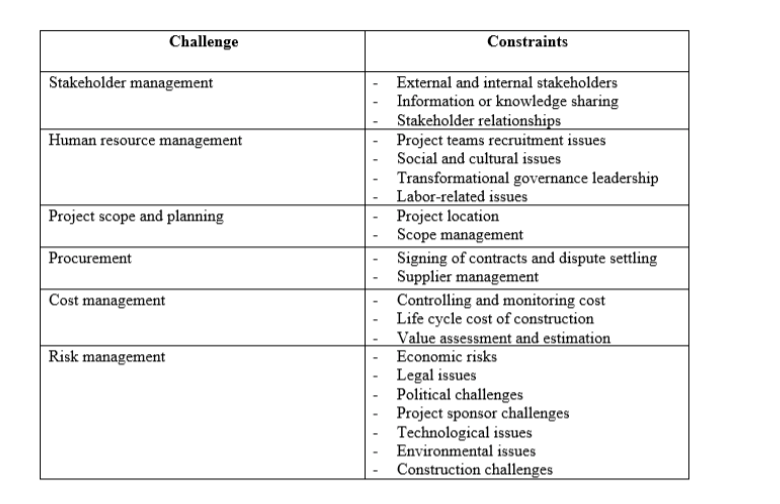
Large-scale business projects perform poorly for a variety of reasons, as the previous section demonstrated. Ineffective project stakeholder and governance supervision, politics, unanticipated environmental hurdles, inaccurate forecasting and budget forecasts, and problems with human resources are a few of these (Essilfie-Baiden, 2019; Nyarirangwe & Babatunde, 2019). Other research suggests that these characteristics be further created in combination with the project delivery stages to pinpoint the precise time in the project cycle (Tabassi et al., 2019). As such, these findings would provide valuable insights for designing and executing appropriate intervention and improvement protocols. It is also necessary to look at the political, technological, and mental aspects of carrying out big projects (Nyarirangwe & Babatunde, 2019; Tabassi et al., 2019). Furthermore, as seen in Figure 1 above, a more comprehensive classification of performance-related elements may be carried out based on project collaboration and framework, management and stakeholders, location, implementation and planning methods, and so on (Nyarirangwe & Babatunde, 2019). Because of how comprehensive this categorization is, Table 2 below shows how firms can utilize it in the comparative evaluation of large building projects.
Table 2. Challenges Related to Managing Complex Construction Projects
Source: Author Illustration
Construction Business Project Management Challenges in Non-Developed Countries
Project Governance Policies
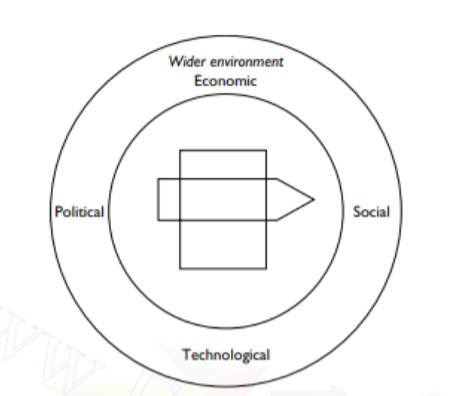
The least developed countries’ leadership has begun to carry out economic reform programs that finance their intricate building business projects with foreign investments made possible by multinational donors. For example, Iqbal et al. (2021) pointed out that although infrastructure projects tend to be complicated and risky, their uniqueness and independence stem from specific sociological, economic, political, and environmental restrictions. Notably, as Figure 2 below illustrates, the vast setting in which the majority of projects are completed has also proven to be more critical and demanding.
Figure 2. Aspects of a Wider Environment
Source: Fewings & Henjewele (2019).
As a broader setting also impacts a project’s prospects of long-term success, it is more important than ever for business project managers and their respective businesses. Less developed countries’ economies rely on their management and infrastructure for expansion and future success (Iqbal et al., 2021). In a nutshell, management in a business is the act of formulating plans, keeping an eye on objectives and needs, selecting projects, and assessing performance (Khan et al., 2019). Furthermore, the efficacy of these endeavors is contingent upon their capacity to oversee the development of infrastructure projects efficiently. As a result, this element is now necessary and a problematic issue for many emerging countries.
Political Interference
Political involvement severely hampers the successful execution and completion of massive building business projects in developing countries. Khan et al. (2019) state that the geopolitical context of most emerging nations substantially influences how fast and seamless development projects move due to sociopolitical and cultural barriers. Multinational ventures are very vulnerable to interference in the assessment and implementation phases, especially in a country perceived as politically unstable (Fewings & Henjewele, 2019). Fewings and Henjewele (2019) point out that a global endeavor is more vulnerable to political unpredictability if its scope is comparable to the nation’s economy or if the project turns out to be strategically significant in some other way. Many projects in developing countries fall into the latter category because they tend to generate in-demand hard currency (Fewings & Henjewele, 2019). Furthermore, local political organizations regularly use patriotic and similar arguments to win over the populace, which might endanger global initiatives (Owusu et al., 2019). In the Ghanaian context, risk indications range from an excessively paranoid bureaucracy to the forced installation of associates from the local community (Ackah, 2020). Political risks can thus be minimized by trying to build solid working connections and concepts with locals in general and elected officials in particular, as well as in attempting to get them to see themselves as part of the decision-making loop.
Corruption
Corruption has affected the project management methods of most developing nations to the point where it now permeates all government-initiated initiatives. Ackah (2020), however, claims that a large number of public leaders in developing nations have actively encouraged and justified this social immorality. As Ackah (2020) notes, when leaders in Ghana propose such a situation, some of the reasons they provide include low income, the business projects failing to be part of their private property, poverty, and gaining social status. Practically every emerging nation engages in corrupt practices, such as soliciting domestic or foreign public officials as well as private firms, illicit transactions, fraud, and conspiracy, even though it is difficult to find a criminal statute that explicitly defines corruption. Gyimah-Boadi, a well-known political scientist from Ghana, asserts that corrupt behavior is pervasive and driven by greed and opportunity (Ackah, 2020). Accordingly, the probability of corruption typically increases when supervision mechanisms are absent, transparency structures and procedures are compromised, and administrators have extremely poor moral integrity (Essilfie-Baiden, 2019). Thus, this phenomenon in society fosters an anti-democratic atmosphere that discourages faith, irrationality, and a deterioration in moral principles that despise democratic structures and government, impeding the execution of initiatives.
Sociocultural Aspects
Given the cultural differences, project managers operate in national and international project environments, presenting challenging problems. According to Tabassi et al. (2019), for example, a lack of cultural understanding may result in conflict caused by misunderstandings and different goals. Serious misunderstandings, arguments, annoyance, and discrepancies that may result from it significantly hamper a business’s capacity to grow and be (Tabassi et al., 2019). The main advantage of the cultural standpoint is that it recognizes that, as opposed to seeing different cultures as an impediment to project success, business project managers must learn to support, preserve, and adhere to them in the modern world (Ackah, 2020; Essilfie-Baiden, 2019; Tabassi et al., 2019). Fewings and Henjewele (2019) also provide illustrations of this element, as shown in Figure 3 below;
Figure 3. Relationship between Business Culture and Environment
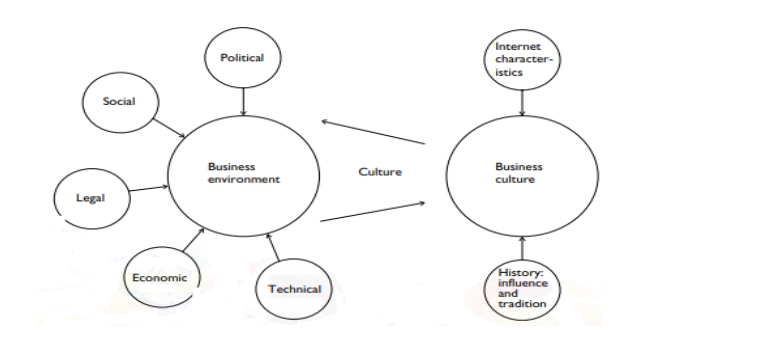
Source: Fewings & Henjewele (2019, p.132).
This point of view assumes that the majority of projects involve a sizable number of different stakeholders from cultural backgrounds. Therefore, varied cultural groupings tend to react differently under similar circumstances because of differences in their underlying ideas and attitudes.
Conclusion
Conclusively, the low level of PM adoption identified for developing countries in the building business industry shows how difficult the practice is. Hurdles likely to occur are politics, inaccurate cost estimates, poor strategy formulation and execution methods, cultural problems, inadequate risk management, erratic scope creep, unclear geological obstacles, poor leadership and stakeholder management, and corruption. Additionally, the study has identified some of the most effective approaches project managers may take to address these challenges. Risks associated with politics may be mitigated, for example, via a bid to build constructive working relationships with elected leaders and the local community to ensure that they feel participating in the decision-making process. The project team must also thoroughly understand regional cultures and customs, along with the underlying principles. The report asserts that team members and project managers must be well-versed in ecological concerns, society, politics, corruption, human resources, and administration to manage their projects efficiently. Thus, placing value on resources and managing changes may substantially aid in lessening such detrimental consequences and raise the results of complicated business projects with improved resource planning and use, risk management, and supervision of changing conditions in developing nations.
.
Offload drafts to field expert
Our writers can refine your work for better clarity, flow, and higher originality in 3+ hours.
Match with writerReferences
- Ackah, D. (2020). Foundations of Project Letdown and Neglect in Ghana. Project Management Scientific Journal, 4(4), 32-44.
- Essilfie-Baiden, E. (2019). Challenges of project management in developing countries. Project Management Scientific Journal, 3(6), 84-88.
- Fewings, P., & Henjewele, C. (2019). Construction project management: an integrated approach. Routledge.
- Iqbal, M., Ma, J., Ahmad, N., Hussain, K., Usmani, M. S., & Ahmad, M. (2021). Sustainable construction through energy management practices in developing economies: an analysis of barriers in the construction sector. Environmental Science and Pollution Research, 28, 34793-34823.
- Khan, A., Waris, M., Ismail, I., Sajid, M. R., Ullah, M., & Usman, F. (2019). Deficiencies in project governance: An analysis of infrastructure development program. Administrative Sciences, 9(1), 9.
- Nyarirangwe, M., & Babatunde, O. K. (2019). Megaproject complexity attributes and competences: lessons from IT and construction projects. International Journal of Information Systems and Project Management, 7(4), 77-99.
- Owusu, E. K., Chan, A. P., & Shan, M. (2019). Causal factors of corruption in construction project management: An overview. Science and engineering ethics, 25, 1-31.
- Akhavan Tabassi, A., Bryde, D. J., Mustafa Kamal, E., Dowson, J., & Michaelides, R. (2019). Challenges for project management in the 21st century. The European Proceedings of Multidisciplinary Sciences.
- Tabassi, A., Bryde, D. J., Mustafa Kamal, E., Dowson, J., & Michaelides, R. (2019). Challenges for project management in the 21st century. The European Proceedings of Multidisciplinary Sciences.
- Tereso, A., Ribeiro, P., Fernandes, G., Loureiro, I., & Ferreira, M. (2019). Project management practices in private organizations. Project Management Journal, 50(1), 6-22.
