




- Tailored to your requirements
- Deadlines from 3 hours
- Easy Refund Policy
OPERATIONAL DEFINITION OF TERMS vii
1.1.2 Commercial Banks in Kenya 4
1.2 Statement of the problem 6
1.5 Significance of the study 8
1.7 The Limitations of the study 9
1.8 Organization of the Study report 9
CHAPTER TWO: LITERATURE REVIEW 11
2.2 Theoretical Literature Review 11
2.2.1 Organizational Contingency Theory 11
2.2.2 The Multiple Constituency Theory 12
2.2.3 Resource-Based View (RBV) Theory 13
2.3 Empirical Literature Review 13
2.3.1 Financial benefits and organizational performance 13
2.3.2 Work environment and organizational performance 15
2.3.3 Job security and organizational performance 16
2.4. Employee satisfaction and organizational performance 17
2.5. Summary of the research gap 18
CHAPTER THREE: RESEARCH METHODOLOGY 21
3.4 Sampling Procedure & Size 22
3.5 Data Collection Instruments 23
3.6 Validity and Reliability of the research instruments 23
3.6.1 Validity of Research Instruments 23
3.6.2 Reliability of Research Instruments 24
3.7 Data Collection Procedures 24
3.8 Data Analysis and Presentation 25
CHAPTER FOUR: FINDINGS AND DISCUSSIONS 27
4.3 Response rate for the questionnaires 28
4.5 Descriptive findings and Discussions 31
4.5.4 Organizational performance 34
4.6 Inferential findings and Discussions 35
4.6.1 Relationship between Financial Benefits and Organizational Performance 35
4.6.2 Relationship between Work Environment and Organizational Performance 36
4.6.3 Relationship between Job Security and Organizational Performance 37
4.6.5 Correlation Analysis Matrix 40
SUMMARY OF FINDINGS, CONCLUSION AND RECOMMENDATIONS 41
4.5.1 Financial Benefits and Organizational Performance 41
4.5.2 Work Environment and Organizational Performance 41
4.5.4 Organizational performance 42
5.2.1 Influence of Financial Benefits on Organizational Performance 43
5.2.2 Influence of Work Environment on Organizational Performance 43
5.2.3 Influence of Job Security on Organizational Performance 44
5.2.4 Organizational performance 44
5.4 Suggestion for further research 45
APPENDIX 1: INTRODUCTION LETTER 50
APPENDIX 2: QUESTIONNAIRE TO THE RESPONDENTS 51
APPENDIX 3: PROJECT TIME PLAN 54
APPENDIX 4: PROJECTS BUDGET 55
SPSS: Statistical Package for Social Sciences
CBK: Central Bank of Kenya
CRB: Credit Reference Bureau
MRPS: Money Remittance Provider
CBR: Central Bank Rate
OPERATIONAL DEFINITION OF TERMS
Employee satisfaction: Describes the positive or negative attitude of a person
regarding their employment and work environment.
Organization: Refers to a social arrangement which pursues collective
goals, controls its own performances, and has boundaries
separating it from its environment
Organizational Performance: Is defined as the accomplishment of organizational
task measured against preset goals.
Employee Performance: Optimal employee productivity as a result of employees
efforts based on what an employer expects from
him/her.
Financial benefits: Is the output and the benefit that employees receive in the
forms of pay, such as wages, overtime, and bonuses.
Work conditions: Refer to the conditions in which an individual or staff member works
including but not limited to quality of air, availability of
office equipment, parking, and the location of the office.
Job security: It refers to the assurance of an employee’s job continuity
as influenced by the nature of his/ her work, employment
type, prevailing economic conditions, and contract type
Bank Managers: In this study, bank managers will include Bank Branch
Managers, Departmental Managers, and Chief Accounts
of various banks that will be included in the study
ABSTRACT
The complexity and aggressive competition in the marketplace have influenced phenomenal changes in the performance of business organizations in the last two decades. Consequently, business organizations have sought ways of improving their performance. The plausible path is coming up with more efficient management strategies that aim to improve employee satisfaction. Employee Satisfaction is key to achieving organizational goals and objectives, such as good customer service and sustainability. This study aimed to examine the effects of employee satisfaction on performance. The case study area was the commercial banks in Kenya, with a specific focus on the branches within Nairobi County. Other aspects covered by the study included causal effects of financial benefits, job security, and the relationship between staff performance and physical work environment within selected commercial banks. The independent variables were the key determinants of employees’ performance, such as financial benefits, job security, and physical work environment. The indicators of Commercial Banks Performance in this study included organizational expansion, employee growth rate, quality of service delivery, employee commitment at work, and good work attendance. The study explored the use of a descriptive study design, and it targets all employees of the selected commercial banks in Nairobi County. A sample size of 410 employees of the selected banks was drawn into the study through a simple random sampling method. The sample size represented 20% of the population size. The study aimed at collecting primary data by administering semi-structured questionnaire to the sampled population. Expert and professional advice of the supervisors was sought to determine and verify the validity of the questionnaires before they were administered. The researcher also administered the questionnaire to 2 commercial bank employees and used Cronbach’s reliability coefficient to measure and estimate the reliability of the research instruments. The reliability of the study technique was tested through a test-retest method. The study used IBM’s SPSS version 20.0 to analyze quantitative data, while qualitative data was analyzed by using the thematic framework, identifying major and consistent themes in the study. Multiple regressions were used to measure the strength of the relationship existing between the independent and dependent variables. The study established that financial benefits, work environment, and job security were positively associated with organizational performance. The study recommended that the Human Resource team should ensure that it sets up conflict management structures as a way of investigating issues of interpersonal relations and resolving conflicts. Organizations should also set aside an adequate budget to purchase equipment for doing the job, such as functional computers and printers. Employees should also be provided with ergonomically designed chairs to enable them to sit upright and more comfortably to deliver. Human Resource Managers should also ensure that the workplace environment is inclusive to accommodate employees living with disabilities by improving accessibility to the office, improving toilet facilities, and facilitating employees with disabilities to access assistive devices. Other inclusive facilities that the organizations should consider putting in place include lactating rooms for mothers with young babies. Managers and the Human Resource team should budget for and regularly review financial benefits available for employees so that the employees can be rewarded based on their work and performance. Lastly, Organizations should assure employees of their job security by offering them permanent contracts or open contracts. Otherwise, the employers should explain to employees the available opportunities in the future and if there is a possibility of long-term engagement.
Table 3. 1: Population Size 21
Table 3. 2: Sample Size 22
Table 4.2: Reliability Analysis…………………………………………………………………..27
Table 4.3: Response rate for the Questionnaires…………………………………………..…….28
Table 4.4.1 Gender Distribution…………………………………………………………………28
Table 4.4:2 Age Distribution…………………………………………………………………….29
Table 4.4:3 Duration of service………………………………………………………………….29
Table 4.4.4 Level of Education………………………………………………………………….30
Table 4.5.1 Descriptive Statistics for Financial Benefits………………………………………..32
Table 4.5.2 Descriptive Statistics for Work Environment………………………………………33
Table 4.5.3 Descriptive Statistics for Job Security……………………………………………..34
Table 4.5.4 Descriptive Statistics for organizational performance……………………………..35
Table 4.6.1 Relationship between Financial Benefits and Organizational Performance………36
Table 4.6.2 Relationship between Work Environment and Organizational Performance……...36
Table 4.6.3 Relationship between Job Security and Organizational Performance……….……37
Table 4.6.4a Model summary………………………………………………………………….37
Table 4.6.4b Summary of ANOVA results……………………………………………………38
Table 4.6.4c Coefficientsa……………………………………………………………………...38
Table 4.6.5 Correlation Analysis Matrix………………………………………………………40
Figure 2.1: Conceptual framework ……………………………………………………20
Figure 4.4.5 Nature of Employment……………………………………………………31
1.1 Background of the study
Schein (2011) explains that in the last two decades, organizational performance has significantly changed due to emerging vigorous competition in the marketplace. Again, the dynamic nature of the business environment has made the majority of business organizations look for better strategies that can enable them to perform well. The major focus has shifted to employee satisfaction as a means of boosting organizational growth and development. The factors that influence employees' satisfaction are both internal and external. Thus, making it complex for the business organizations to deal with. Goslin (2005) expressed that employee satisfaction affects various organizational performance variables, including physical expansion, net income, and number of employees, financial sustainability, and increased market share. Richard (2013) added that the performance of an organization is described by the financial performance variables such as return on profits, sales volume, asset investment, shareholder returns, and market share, among other variables. According to Thomas P. & Robert Waterman (2014), a good performing organization is one that is focused on its customers, continuous learning, self-sufficiency, and business skills. Ittner and Larcker (2012) assert that the measure of organizational performance consists of indicators such as quality, efficiency, productivity, consistency, professional development, including leadership training for workers to furnish them with the requisite skills and attitudes. Harter, Schmidt, and Hayes (2002) revealed that a positive correlation exists between organizational performance and employee satisfaction. According to research findings by Ostroff (1992), organizations with high levels of employee satisfaction tend to perform better than those with low levels of employee satisfaction. A study done by Ryann, Schmitt, and Johnson (1996) revealed that there are associations between business performance, customer satisfaction indicators, and employee turnover ratios.
Globally, the banking sector has been battling with many challenges that are believed to be influencing their performances, for example, employee relations has been one of the concerns in the sector. Due to the different cultures that bank employees come from, cases of conflicts have occurred, especially where people work in a common setup. Other concerns have been a lack of adequate skills to perform a task, an inadequate system to perform the task, e.g., managerial behavior, the effect of co-workers' behavior, and resource distribution.
Other possible causes of employee dissatisfaction include convoluted bank processes that provide a lot of hardship, incessant conflict, and behavioral effects, turnover due to economic issues and labor market conditions, poor compensation, poor fit of the employee and the job, a very poor working environment, and monotony. Based on the Central Bank of Kenya’s report of 2016, the banking industry, especially in Sub-Saharan Africa, is experiencing underperformance challenges. The performance of the sector in Sub-Saharan Africa has plummeted to 1.4% in 2016 from 3.4% in 2015. Countries exporting oil, such as Nigeria, as well as other countries with superior resources, have witnessed a great decline. For example, Nigeria's growth plummeted to -1.5% in 2016 from 2.7% in 2015. Despite most commercial banks which are operating in Kenya have remained resilient to major changes in the sector such as capping of the interest rates, some of the banks experienced underperformance related challenges hence completely withdrawing their services in some places in Kenya and even laying off employees to reduce the financial burdens that never matched revenue generated. With the prevailing circumstances in the banking sector, every bank is striving to remain competitive in the market, which can only be achieved through good performance. It is, therefore, necessary for the bank managers to understand employee satisfaction effects on performance and realize strategies that would improve employee satisfaction and performance of the banks as well.
1.1.1 Employee Satisfaction
Employee satisfaction is often used to describe one's state of mind toward work. It describes a person's attitude and feelings on various inherent and extrinsic fundamentals about his/her job and the employer. Simatwa (2011) projects that such fundamentals include interpersonal relationships within the workplace, supervision, nature of work, benefits, compensation, and promotion. Similarly, Cascio (2002) states that employee satisfaction constitutes attitude and feeling towards pay, supervision, work conditions, relationship with co-workers, promotion, benefits, contingent reward, communication, nature of work, participation, and performance evaluation system of the organization. The author added that employee satisfaction is well-connected to human resource management. Previous studies have revealed that good practices of human resource management can provide a great competitive advantage in terms of major objectives of an organization, such as productivity, profit, and quality of life.
A clear relationship can be seen between employee satisfaction, employee engagement, and retention. Employee engagement could be described as the level of psychological investment that an employee gives to an organization. Satisfied employees mostly demonstrate a high level of engagement in their organizations, hence high organizational performance. According to AON (2017), global employee engagement has fallen. The author asserts that both trends and levels of engagement vary greatly across the world. The variability in the level of engagement level could be due to differences in some cultures. Additionally, factors such as economic or political stability can influence the level of engagement. Some research indicated that the measure of the likelihood of employees remaining at their current workplace plummeted from 60% to59% between the years 2015 and 2016, respectively. The study also indicated that there was a drop in the strive component, i.e., the willingness to give extra effort. It went down by 1%, i.e., from 64% to 63%. According to the author, the African continent gained in employee engagement scores in the year 2016. The talent and staffing dimensions, which are a measure of how sound organizations attract, develop, and retain their employees, increased from 59% to 61% from 2015 to 2016. This was attributed to an improvement in employee satisfaction. The findings imply that organizations will always tend to focus more on sustaining a high level of staff engagement to ensure employee satisfaction within the work environment.
Brighter Monday (2018) conducted a research in Kenya on employee satisfaction and revealed that job satisfaction level was low in both male and female, but lower in female respondents, who even posed a greater flight risk. The research findings also revealed that female respondents were not as willing to continue working for their current employer due to low engagement and satisfaction levels. The banking sector is no exception. The Brighter Monday (2018) reports that in the top 100 best companies to work for, which shows a high level of employee satisfaction, only 3 banks featured, i.e., Kenya Commercial Bank, Equity, and Cooperative Bank, out of 43 commercial banks in Kenya. This reveals how employees' satisfaction in most of the banks in Kenya is still low.
The level of employee satisfaction in every organization is vital since it influences the retention and attraction of competent employees in the organization. It also helps managers to understand how employees feel about their job, hence predict work behaviors such as absenteeism and turnover. A satisfied employee tends to register a good attendance record and is likely to remain effective and loyal to the organization. According to Adhikari (2009), a dissatisfied worker has negative attitudes, misses work more often, has a poor relationship with the supervisor, is always stressed, and disloyal to the company. As a result, there is a need for every organization to create a working environment that satisfies its employees.
Employee satisfaction and productivity are performance dimensions that are linked to organizational performance. In other words, an employee's satisfaction is directly linked to organizational performance. Satisfied employees demonstrate a high level of involvement in their organizations. In this study, the researcher will narrow down to salary, physical work environment, and job security factors to measure employee satisfaction among members of staff in selected commercial banks within the county of Nairobi.
1.1.2 Commercial Banks in Kenya
A commercial bank is a financial intermediary that offers financial services to the general public and other companies. It generates funds mainly through deposits from clients who are either consumers or business persons. The deposits include checkable deposits, savings, and term deposits. Commercial Banks also provide loans to clients to earn interest for them. In the Kenyan economy, bank service providers play a pivotal role, including an increase in savings; people deposit their money in Banks that earn profits/interests after some time. It also enables consumers and the national government to borrow money and invest in businesses and public works, respectively. Through investments, more jobs are created, and developments are achieved in less developed areas. The inception of commercial banking in Kenya began was introduced in 1896 from the National Bank of India. In the 19th century, the sector began picking up due to the birth of commercial connections in East Africa, for example, in 1910, Standard Bank of South Africa was established, followed by the Anglo-Egyptian Bank Limited and National Bank of South Africa, which were merged to operate as Barclays Bank in 1916. As the economy developed, excellent opportunities began to rise that attracted the emergence of different banks specifically in towns. The year 1951 saw the establishment of the General Bank of the Netherlands, after which the Bank of India and the Bank of Baroda were established two years later in 1953. Many other banks continued to be born, such as the Commercial Banks of Africa and the Ottoman Bank in 1955, Habib Bank Ltd in 1956, and the Cooperative Bank in 1968. National Bank of Kenya emerged in the year 1968-after taking over from Ottoman. National and Grindlays Bank (1971), the current Stanbic Bank, American Bank (1974). Since independence, there has been significant growth in the banking industry in Kenya. This is indicative of growth toward economic prosperity (Central Bank of Kenya, 2016)
Kenya is reported to have reached a landmark of 43 banking institutions by 31st December 2016. The majority (42) of the institutions were commercial banks, while the remaining one was a mortgage financing institution. These were being regulated by the CBK. Other financial institutions included 3 credit reference bureaus, 8 offices representing international banks, 77 international exchange bureaus, 13 Microfinance Banks, and 17 money remittance providers. Among 43 commercial banks, 40 belonged to private investors (25 owned by the local institution and 15 owned by the foreign institution), while 3 were owned by the government of Kenya. Among the 25 owned by the local financial institution, 24 were commercial banks, while 1 was a mortgage financing organization. Out of the 15, which belonged to the international organizations, 11 commercial banks were local subsidiaries of the international banks, and 4 were branches of international banks. However, Banking Supervision Annual Report-BSAR (2016) noted that every financial institution, such as providers of money remittance, forex bureaus, credit reference bureaus, and microfinance banks, which were licensed, belonged to private owners. The Kenyan commercial banks belong to a statutory body called the Kenya Bankers Association (KBA) that lobbies for issues that affect the banks and their employees. Currently, the sector is battling several challenges, for example, coping with the new Banking Amendment Act, 2016, which capped the interest rates at not more than 4 percent above the prevailing Central Bank Rate that the licensed banking institutions registered under the Banking Act charge on loans. Due to the new act, banking profitability has gone down; hence, the financial institutions have not been able to make an adequate return on investment or return on equity as required by the shareholders. Banks are facing too much pressure to meet clients' expectations in terms of service delivery, and lastly, increasing competition from other financial service institutions such as Savings and Credit Cooperative Organizations. The outcomes of the challenges that the banks have been going through in Kenya include the closure of various commercial branches, massive lay-offs, and a high attrition rate of bank employees. Therefore, banks must adopt strategies that would improve employees’ satisfaction and performance.
1.2 Statement of the problem
The banking sector is a very competitive industry as every bank strives to maintain good performance and remain viable in the market. To achieve this, commercial banks must achieve good operating results and remain financially healthy. They can only accomplish this by attracting and retaining employees that are efficient and produce financial results that satisfy their stakeholders and regulators. Many organizations have always found it challenging to manage employee performance. However, every organization strives to find and adopt the most effective strategies to satisfy and retain employees in order to achieve and deliver high performance, and thus remain competitive in the market. Satisfied employees are more likely to meet the expectations of the role and thus assist the organization in achieving its strategic goals and objectives. Improved organizational performance has been linked to employees’ job satisfaction and increased level of engagement. It is been proven that high levels of employees’ satisfaction and commitment have yielded high productivity in organizations.
Despite most of the commercial banks in Kenya remaining resilient to major changes in the sector, such as capping of the interest rates, some of the banks experienced underperformance-related challenges, hence completely withdrawing their services in some places in Kenya and even laying off employees to reduce the financial burdens that never matched revenue generated. Employees experience more workload and pressure to serve the increased number of customers. Some employees struggle to walk out of performance improvement plans (PIP), where they find themselves due to the inability to achieve workplace goals and targets, leading to psychological issues. It is for these reasons that the researcher finds it feasible to conduct further study on the effects of employee satisfaction on commercial banks’ performance in Nairobi County. The findings from the study will provide in-depth knowledge of what determines employee satisfaction and how their satisfaction influences their performance.
Eliphas, Mulongo, and Razia (2017) examined the effects of performance appraisal practices on employees’ productivity, and they discovered that tools of performance appraisal, like recognition and feedback, are very valuable in evaluating employees’ performance since they indeed influence employees’ productivity within a financial institution. The study was done in Tanzania, but not in Kenya or the banking sector. Their research focused on how performance appraisal practices affect employees’ productivity, while this study will focus on the effects of employee satisfaction on commercial banks’ performance in Nairobi County. Kithuku (2012) established that job satisfaction among employees is affected by performance appraisal practices within Kenya’s KCB bank. It also noted that employees’ level of satisfaction can be negatively or positively affected by the bank’s performance appraisal practices. The study concluded by pointing out that a bank’s performance and job satisfaction level among employees are affected by the bank’s choice of performance appraisal methods to a great extent. However, the current research will investigate the impacts that employee satisfaction has on selected commercial banks’ performance within Nairobi County. Another study by Ndung’u (2016) examined how reward systems within commercial banks operating within Nakuru town enhance the motivation of the bank’s employees. The study revealed that career rewards played a crucial role in improving the motivation of the sampled employees. However, this study intended to concentrate on determining the employee satisfaction effects of selected commercial banks' performance within Nairobi City County, Kenya.
1.3 Objectives of the study
1.3.1 General Objective
To examine the employee satisfaction effects of selected commercial banks' performance within Nairobi City County, Kenya.
1.3.2 Specific Objectives
They included;
- To find out the degree of influence of financial benefits on commercial banks’ performance within Nairobi County.
- To establish the level and direction of the influence of the work environment on commercial banks’ performance within Nairobi County.
- To determine the effects of job security on commercial banks’ performance within Nairobi County.
1.4 Research Questions
The study was guided by fundamental questions listed below.
- How have financial benefits influenced commercial banks’ performance within Nairobi County?
- How has the work environment influenced commercial banks’ performance within Nairobi County?
- What effects does job security have on commercial banks’ performance within Nairobi County?
1.5 Significance of the study
The findings of this study are expected to contribute significant knowledge of what determines employee satisfaction and how their satisfaction influences organizational performance. Such insights will enable bank managers to come up with appropriate interventions to advance performance and remain relevant in the competitive sector. The HR practitioners will gain an understanding of the significance of employee satisfaction within financial institutions, and therefore explore better strategies that would enhance an organization's and employees’ performance. Moreover, the effects of employee’s satisfaction on their performance will gain widespread applicability even outside the banking sector, thus the results will be appointer towards what would happen in other sectors of the economy, and finally, other researchers and students in the Human Resource Management field would find this study a valuable guide on discussions about how employees satisfaction relate to their performance.
1.6 The Scope of the Study
The researcher undertook the study within Nairobi County, where employees of the selected commercial banks were the targeted population. However, due to limitations in terms of resources and time, only 410 employees were sampled for the study. The sampling was done through a series of steps whereby a sample of 10 banks was generated through stratified sampling from a sample frame of different categories of banks in Kenya, including tier 1 Banks, which comprise large banks with hundreds of billions in cumulative assets and millions of depositors, and tier 2 banks, which are medium-sized lenders. They control 41.7% of the market share, and tier 3 banks, which are the final level of banks that control 8.4% of the market. Then stratified sampling was used to sample 410 employees who were targeted for the study. A descriptive research design was utilized to facilitate summarization of the characteristics of different subjects of the study and measure their beliefs, attitudes, and habits among other social issues, while inferential statistics was used to infer findings from the sample to the general population.
1.7 The Limitations of the Study
The study measured organizational performance based on operational measures of commercial banks’ performance, such as customer satisfaction, quality of service delivery, and employee growth rate. However, to realize the holistic performance of the commercial banks, financial indicators of the commercial banks' performance, such as Return on Assets, Return on Investments, etc., ought to be explored. This was not achieved due to inadequate time. However, the study included the managers of the commercial banks who provided useful data for the triangulation of the findings. During data analysis, the performance of commercial banks had few financial indicators of commercial banks' performance reported; hence, the researcher capitalized on the data provided by the employees on sales growth rate (SGR), employee growth rate (EGR), and customer satisfaction (CS) to triangulate with other available data to estimate the holistic performance of the commercial banks. And lastly, it was difficult to identify the most optimal time that needs to elapse for the effect of employee satisfaction to become noticeable. The concern is identifying the optimal time lag. This study analyzed job satisfaction for a period of one year. However, a comprehensive analysis requires long-term monitoring and analysis of employees’ satisfaction and performance of an organization. Such prolonged monitoring would allow for observation of an accurate relationship between the study variables. As a result, the generalization of findings from this study will be restricted at the time of the research.
1.8 Organization of the Study Report
This report is structured in a chapter format, i.e., chapter one, chapter two, chapter three, chapter four, and chapter five. Chapter one introduces the study by highlighting the concept of employee satisfaction, a brief history of commercial banks in Kenya, the problem statement, the objectives of the research, the research questions, the significance of the study, the scope, and the possible limitations of the study. Chapter two gives a review of existing empirical and theoretical literature on employee satisfaction and its effects on organizational performance, especially in the banking sector. This chapter discusses organizational contingency theory (OCT), the multiple constituency theory (MCT), and resource-based view theory (RBV) as the major theories of organizational performance. This chapter also advances and analyzes the empirical data that presents existing literature on the effects of financial benefits, work environment, and employee satisfaction on organizational performance. Chapter four presents and discusses data findings, while Chapter 5 makes a conclusion by outlining key research findings and recommendations based on the findings.
CHAPTER TWO: LITERATURE REVIEW
2.1 Introduction
Literature review entails the presentation of relevant literature relating to the topic of the study. For this study, literature relating to employee satisfaction and its effects on organizational performance will be reviewed, especially within the confines of the commercial banks sector. It will focus on theoretical reviews of the variables under the current study and previous studies on the subject matter in order to provide a suitable framework for drawing contrasts and comparisons of the study findings. The chapter will also give insight into the research gaps that exist and will provide a conceptual framework to present graphical connections among the study variables. Under theoretical review, the research examines organizational contingency theory, multiple constituency theory, and RBV Theory. The empirical review will involve the research findings that have drawn the links between employees’ performance and financial benefits, work environment, and job security. These will be examined from the employee satisfaction perspective and how it influences organizational performance, especially in commercial banks. Finally, the conceptual framework will be guided by the following job satisfaction factors (financial benefits, work environment, and job security) as the independent variables and measures of commercial banks' performance (customer satisfaction, quality of service delivery, organizational expansion, sales, and employee growth rate)
2.2 Theoretical Literature Review
2.2.1 Organizational Contingency Theory
Cameron and Whetton (1987) opined that organizational performance is complex; hence, there is no universal model that understands/explains it all. However, several models and theories have been advanced to help understand how job satisfaction relates to organizational performance. One of such models is organizational contingency theory. The theory hypothesizes that there is no single structure that is ideal for all organizations to achieve optimal performance. However, the most effective structure is that which would fit certain factors known as contingencies. Fiedler equated these contingencies to unique situations that should be addressed for an organization to achieve optimal performance. According to Fiedler (1967), optimum organizational performance is contingent upon various internal and external constraints. Various organizations may have different contingencies or factors to consider in order to record high performance. These factors may include salary, workplace environment, job security, nature of work, organizational size, peer-to-peer interactions, and other factors that affect organizational performance and employee satisfaction. The theory recognizes contingency factors that an organization needs to address in order to record high performance, and thus makes it relevant to the study. These contingency factors may be unique to every organization, and among them may be factors that influence employees’ satisfaction, such as job security, condition of the work environment, and financial benefits, which are key variables in this study. As such, this study seeks to examine the effects of the factors mentioned above on the performance of an organization, and specifically within the commercial banks in Nairobi County. The assumption drawn from this theory is that managers should always adhere to the needs of the prevailing situations. However, this may always prove practically challenging in the real work situation. Determination of situations that inform managerial actions and decisions involves an analysis of several variables with multiple dimensions. Therefore, it is likely that managers who have little time for research may fail to thoroughly analyze all variables that affect organizational performance and may resort to an easier way by taking shortcuts.
2.2.2 The Multiple Constituency Theory
This theory evaluates organizational performance from the perspective of its suitability to meet the stakeholders’ objectives. This is quite important because stakeholders play the role of providing financial resources to an organization. This theory emphasizes two concepts. The first concept argues that organizations consist of several smaller groups with differing interest categories, while the second concept holds that organizations consist of diverse categories of external stakeholders whose concerns are distinct ( Balser & McClusky, 2005). This theory asserts that it is impossible for an organization to fully satisfy the interests of all its stakeholders. However, by comparison, an organization will strive to meet most of the interests of the stakeholders who provide more critical resources to the firm. But the stakeholders who provide few resources, their interests will come second. This theory validates the study since it identifies different stakeholders who make an organization survive. It acknowledges that the stakeholders have different interests that need to be satisfied for an organization to achieve optimal performance. Based on this theoretical context, the researcher identified employees among the stakeholders who provide more critical resources, such as customer service and retention within commercial banks, hence their interests, such as financial benefits, job security, and work environment, which influence the organizational performance. However, the theory has been criticized on the basis that it assumes that an effective organization is one that is successful at exploiting its environment of scarce resources. The more resources the organization gains, the more effective it is judged. It assesses organizational effectiveness based on inputs rather than outputs. Additionally, this orientation tends to focus attention on organizational survival rather than on effects or outcomes in the quality of service rendered
2.2.3 Resource-Based View (RBV) Theory
This theory explores the internal resources that an organization possesses to formulate strategies to achieve sustainable competitive advantages. This theory focuses on how management gives attention to internal resources to identify assets, capabilities, and competitive advantage. Barney (1991) groups resources into three categories: organizational capital resources (formal structure), human capital resources (insights, experience, and training), and physical capital resources (equipment, plant, physical, and technological). The RBV theory identifies human resources as one of the most valuable resources that management must focus on in order to have a competitive edge in the market environment. Because of its cognizance of the fact that human resource constitutes the most valuable resources that organizations need to focus on to ensure maximum employees’ performance and organizational productivity, makes this theory relevant to this study. Therefore, organizations need to formulate strategies that promote job satisfaction while competing in their external business environment. Despite the theory being relevant to the study, its two major assumptions are that resources must be immobile and heterogeneous. It argues that skills and other resources within the organization must be heterogeneous for an organization to employ different strategies to outcompete each other. The other assumption of this theory is that resources are not mobile, hence companies cannot replicate the same strategies to outcompete their rivals.
2.3 Empirical Literature Review
2.3.1 Financial benefits and organizational performance
According to study conducted by Aryan & Singh (2015) in Haryana and Punjab, India, to investigate the impact of recognition and motivation on employees’ performance in private and public banks, it was proven that employees’ performance is greatly influenced by factors like salary and other monetary and non-monetary benefits that the organization provides. Incentives and other financial rewards provided by the organization significantly affect employees’ job performance. There is a high expectation from employees that they should be rewarded for meeting specific criteria above and beyond normal duties. Financial incentives polish employee performance and develop a brighter organization’s performance. The study also revealed that non-monetary rewards like recognition also play a significant role in improving the employees’ performance. A study conducted in Pakistan by Khan and Farooq (2010) to examine how employee motivation is affected by commercial banks’ reward systems indicated a positive connection between rewards and employee motivation. The study revealed that motivated employees are more energetic and productive in their work. Recognition and reward play a vital role in enhancing employees’ performance since they make employees feel valued. Matthew et al (2009) also conducted a study that showed a positive correlation between organizational effectiveness and employee motivation. According to Schuler and Jackson (1996), the connection between recognition, rewards, and employee motivation is strategically significant to the success of an organization.
A study conducted by Eliphas, Mulongo, and Razia (2017) in Tanzania, which examined the influence of performance appraisal practices on the productivity of employees, found that performance appraisal tools such as feedback and recognition are vital for employees’ performance. However, the study found no relation between promotion, training, and development and the productivity of employees. The study focused on appraisal and the productivity of employees, while the proposed study will examine the effects of employee satisfaction on performance. Kithuku (2012) investigated the effects of performance appraisal on job satisfaction at the Kenya Commercial Bank. In the analysis of her research, she found that the performance appraisal method used can have both a positive and a negative impact on the performance of employees. Job satisfaction levels among employees can also be reflected in many ways, such as the rate of employees' turnover, level of teamwork, time management by the staff, career development, job rotation, and employees’ productivity or their performance at the workplace. The study concluded that the level of job satisfaction among staff members can be impacted positively or negatively by performance appraisal. Therefore, the method of undertaking performance appraisal has a direct impact on employees’ job satisfaction and job performance.
Ndung’u (2016) investigated the role of reward systems in enhancing employee motivation in Commercial Banks in Nakuru town. The study revealed that there was a significant correlation between the career reward system, the performance-based reward system, and the motivation of employees. The researcher observed that surveyed commercial banks had a performance-based reward system in place and regularly evaluated employees' performance. The study thus concluded that career rewards were crucially important in enhancing employee motivation. The proposed study will investigate the effects of employees’ job satisfaction on organizational performance in the selected commercial banks within Nairobi County.
2.3.2 Work environment and organizational performance
Many organizations across the world are faced with numerous shortcomings because of the dynamic nature of the business environment. Every organization strives to remain competitive in the changing business environment by adopting strategies that aim at satisfying and retaining its employees. Every organization ought to provide a job-satisfying environment in order to increase its productivity, employees’ commitment, and efficiency. Raziq (2015) revealed a significant relationship between the work environment and employee satisfaction. The study investigated the relationship between work environment and job satisfaction among employees in the banking sector, educational institutes, and the telecommunication industry within the city of Quetta, Pakistan. Prospectively, the study concluded that business organizations should create a healthy working environment to realize the optimal level of job satisfaction among employees. Leblebici (2012) indicated that employees’ productivity and organizational performance thrive well in a work environment where employees feel comfortable and motivated due to good working conditions. Organizations with healthy physical work conditions tend to have a competitive edge over others. It has been revealed that improving the work environment reduces complaints and absenteeism among employees and, at the same time, increases productivity (Roelofsen, 2007). A study done by Chevalier (2004) indicates that “when environmental supports are sound, employees are better equipped to do what is expected of them”. This is supported by Chandrasekar 2003 that the work environment plays a big role in increasing employee performance. Hameed & Amjad (2009) surveyed a total of 31 branches of the commercial banks and found that employees are more motivated when they work under a comfortable and ergonomic office design. As such, their level of performance increases in such work conditions.
According to Chandrasekhar (2011), an organization needs to be conscious of creating a work environment that enhances the employees’ satisfaction to increase the organization’s profit. He believed that employee relations in an organization play a more important role in the overall job satisfaction rather than money, while management skills, time, and energy are all needed for improving the overall performance of the organization in the current era. Ollukkaran & Gunaseelan (2012) conducted a study about “The impact of work environment on employee performance of manufacturing companies”. The findings of the research revealed that the work environment impacts employee morale, productivity, and engagement both positively and negatively. In other words, the quality of the work environment is among the most important factors that affect an employee’s morale and organizational performance. The extent to which employees engage with their immediate work environment influences their level of error, innovation, collaboration, absenteeism, and loyalty to the organizations they work for. The impacts of an inadequate working environment on employee performance have been evident in low- and middle-income countries. For example, in Tanzania, studies that have been done in the health sector have revealed that the work environment affects competency, productivity, and availability. The studies focused mainly on the influence of the work environment on the combined effects of responsiveness, productivity, competence, and availability as elements of health workers’ performance in child health care and reproductive health (Oswald, 2012). The research focused on health workers in a hospital setup, while the proposed study intends to establish the influence of the physical work environment/conditions on commercial banks’ performance within Nairobi City County.
2.3.3 Job security and organizational performance
James (2012) indicated that job security significantly impacts the overall organizational performance. He observed that organizations that don’t guarantee job security to their employees experience low morale among employees due to loss of faith, consequently affecting the performance of the organizations. He asserts that “the more an employee enjoys high job security, the more he is likely to effectively perform his task”. This consequently impacts the overall performance of an organization. However, research conducted by Subramaniani et al. (2011) that linked organizational performance and human resource practices in small and medium firms (SMEs) in Malaysia revealed that job security is less significantly related to organizational performance. Only a few studies have been done on job satisfaction and performance in the commercial banking industry. The scanty information on the impact of job security on the performance of the banking sector contradicts hence this is an area that still needs more and in-depth investigation.
2.4. Employee satisfaction and organizational performance
Islam, Mohajan, and Datta (2012) found that job satisfaction played a vital role in the overall performance of commercial banks in Bangladesh. The study also revealed that supportive colleagues, social status, and a sense of security about the job were the top three reasons that make employees feel happy working in the banks. The study also revealed that promotional policy, decision-making authority, and payment were the three top priorities for improving the work environment. Brooks (2014) revealed that a positive correlation exists between job satisfaction and financial performance. The research was carried out in Pennsylvania Community Banks in India, and it showed that there was a strong positive correlation between employees’ job satisfaction and the profitability of the bank. Miller, Erikson & Yust (2008) assert that employees with higher levels of job satisfaction are probably able to perform better and assist the organization in achieving its strategic objectives. Since the organizational capacity to accomplish stated objectives and goals is partially dependent upon the capabilities and resources of its human capital, the ability to recruit, develop, and retain highly motivated employees is an essential characteristic of any successful organization (Moynihan & Pandey, 2007).
Additionally, Bahmanabadi (2015) revealed that leadership styles such as transformational, relation-oriented, and transactional had significant positive impacts on both employers' and employees’ job satisfaction in Sweden. The study further indicated that the transformational approach made the most contribution towards job satisfaction compared to the relation-oriented and transactional styles of leadership. Arshadi (2010) examined basic need satisfaction, work motivation, and job performance, and summed up his findings that autonomy support predicted satisfaction of three psychological needs, which, in turn, predicted work motivation and job performance. Besides, need satisfaction partially mediated these relationships. Similarly, Singh (2013) evaluated employees’ job satisfaction and its impact on their performance and concluded that happy workers are productive workers and productive workers are likely to be happy. Employee job satisfaction is essential to face the dynamic and ever-increasing challenges of maintaining the productivity of the organization by keeping its workforce constantly engaged and motivated. Furthermore, he argued that environmental pressures, rising health costs, and various needs of the workforce also pose a challenge for the management. This could be overcome by creating a friendly environment for work that maintains employee job satisfaction and motivates people towards exceptional performance at the workplace.
2.5. Summary of the research gap
The research carried out by Khan and Farooq (2010) that examined the effects of rewards on employees’ motivation in the commercial banks sector in Pakistan gave an insight into the topic. The researcher investigated the effects of rewards on employees’ motivation. Therefore, the current study will probe the extent to which salary influences employees’ performance in commercial banks within Nairobi County. The research by Eliphas, Mulongo, and Razia (2017) examined the influence of performance appraisal practices on employees’ productivity in banks in Tanzania. Their research focused on performance appraisal practices on the productivity of employees. Nonetheless, the current study focuses on employees’ satisfaction and its effects on the performance of commercial banks within Nairobi County. Kithuku (2012) examined the effects of performance appraisal on job satisfaction at Kenya Commercial Bank, while the current study will examine the effects of employee satisfaction on the performance of commercial banks in Nairobi County. A study carried out by Ndung’u (2016) examined the role of reward systems in enhancing employee motivation in commercial banks in Nakuru town. However, the current study, instead, focused on the influence of financial benefits on the performance of commercial banks in Nairobi County.
Little is known about the effects of the physical work environment on performance, especially in commercial banks. Most of the studies that have investigated the effects of the work conditions on the performance have not focused specifically on the banking sector, for example, Ollukkaran & Gunaseelan (2012) investigated the impact of work environment on employees’ performance in manufacturing companies. This scanty information about the impacts of job security on the individual and organizational performance in the commercial banks sector leaves huge gaps for further studies. The little available information seems to have contradicting findings; for example, James (2012) indicated that job security has a significant effect on the overall organizational performance. However, a study carried out by Subramaniani et al. (2011), which investigated the relationship between the organizational performance of small and medium firms (SMEs) and human resource practices in Malaysia, indicated that organizational performance and job security do not have a significant relationship. Therefore, there was a need to carry out further investigations to draw significant links between job security and employees’ performance in commercial banks.
2.6 Conceptual framework
Fig 2.1 A conceptual framework of the inter-relationship between variables in the study.
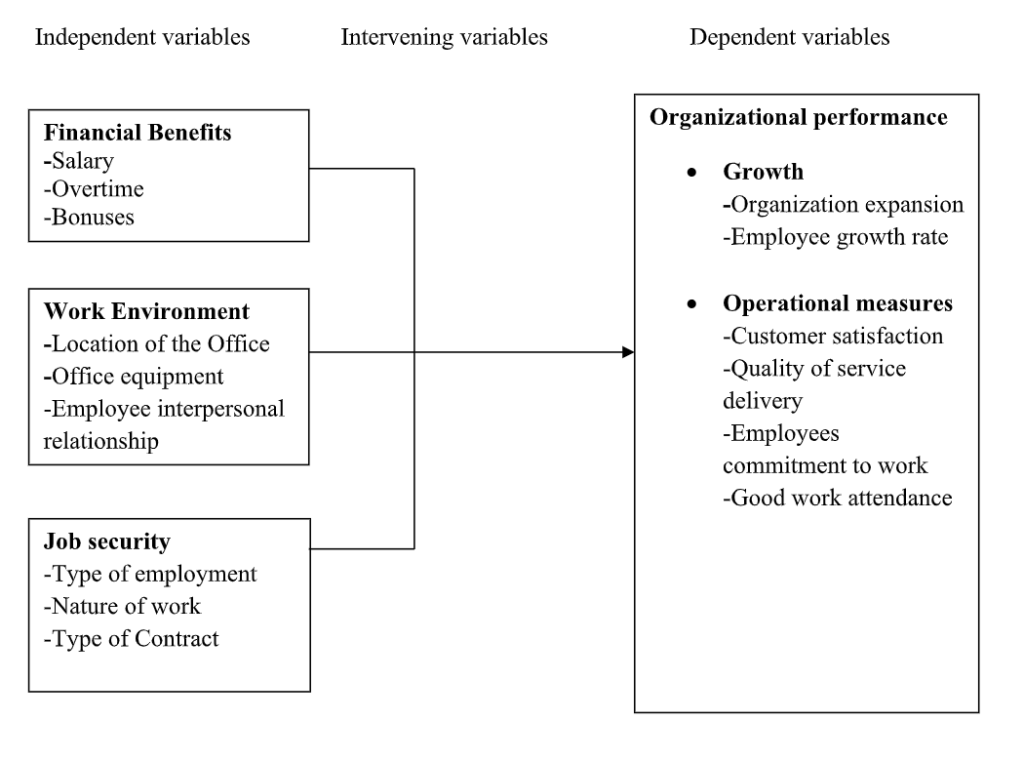
Organizational performance
- Growth
-Organization expansion
-Employee growth rate
- Operational measures
-Customer satisfaction
-Quality of service delivery
-Employees commitment to work
-Good work attendance
Put your paper in expert hands
Get a custom essay written to your exact requirements – researched, structured, and delivered on time.
Write my essayFinancial Benefits
-Salary
-Overtime
-Bonuses
Work Environment
-Location of the Office
-Office equipment
-Employee interpersonal relationships
Job security
-Type of employment
-Nature of work
-Type of Contract
The independent variables included the causes of employees’ satisfaction in commercial banks, while the dependent variables are the job satisfaction outcomes on the performance of banks. Financial benefits, work environment, and job security are the key determinants of employee’ satisfaction, which may affect the performance of banks within Nairobi County. Many organizations track and measure performance in many dimensions, including service, social responsibility, financial performance, and employee stewardship. This study, therefore, adopted both financial (sales growth rate, employee growth rate, organizational expansion) and operational measures of performance in the banking industry.
CHAPTER THREE: RESEARCH METHODOLOGY
3.1 Introduction
Research methodology constitutes research design, procedures, and techniques that the researcher uses to conduct research. Therefore, this chapter highlights the study framework, location, the population of interest, and the respondents. The process that will be used to include participants in the study has also been demystified. Other areas of focus include tools and instruments that the researcher will deploy in the study, the methods of data collection and analysis, and the ethics that the research will abide by.
3.2 Research design
Orodho and Kombo (2003) stated that a research design shows how the problem under study will be addressed. This study utilized the descriptive research design, questionnaires were prepared and administered to the respondents to enable the researcher to collect the required data about the characteristics of interest of the population under the study, and thus measure their attitudes, opinions, habits, and other social issues.
3.3 Target Population
This is the composition of events, things, or people that are of interest in a study (Mbwesa, 2008). The study was conducted in Nairobi County. The study targeted a total of 2050 employees in the 10 selected commercial banks. Nairobi County is chosen as the study area because it is representative of all the commercial bank branches countrywide. A report by the Central Bank of Kenya (2016) stated that over the years, Nairobi has registered the highest number of branches, which stood at 611 as of 31st December 2017, compared to any other county in Kenya.
|
No |
Sampled banks |
Managers |
Staff |
Total Population |
|
1 |
Family Bank |
14 |
196 |
210 |
|
2 |
Chase Bank |
12 |
168 |
180 |
|
3 |
National Bank |
8 |
112 |
120 |
|
4 |
I & M Bank |
6 |
87 |
93 |
|
5 |
CBA Group |
7 |
108 |
115 |
|
6 |
Equity Bank |
20 |
290 |
310 |
|
7 |
KCB Bank |
20 |
312 |
332 |
|
8 |
Barclays |
20 |
280 |
300 |
|
9 |
Standard Chartered Bank |
20 |
205 |
225 |
|
10 |
NIC |
11 |
154 |
165 |
|
Total |
10 |
138 |
1912 |
2050 |
Source: Researcher (2018)
3.4 Sampling Procedure & Size
Kothari (2004) defined sampling procedure as a process of choosing part or totality of a population to include in a study to use to test hypotheses and to make inferences about the part or totality of the population. A multi-stage sampling was utilized to sample the respondents for the study. The sampling was done through a series of steps whereby a sample of 10 banks was generated through stratified sampling from a sample frame of different categories of banks in Kenya, including tier 1 Banks, which comprise large banks with hundreds of billions in cumulative assets and millions of depositors, and tier 2 banks, which are medium-sized lenders. They control 41.7% of the market share, and tier 3 banks, which are the final level of banks that control 8.4% of the market. Then, simple random sampling was used to sample a total of 410 respondents from a population of 2050 employees of the sampled commercial banks. This represented 20% of the target population. Amedeho (2002) and Mugenda & Mugenda (2003) assert that a sample size between 5-20% is suitable for representing the entire population, and at least 10% of the accessible target population is appropriate for statistical reporting, respectively.
|
No |
Sampled banks |
Employee |
Population Size |
Factor |
Sample Size |
|
1 |
Family Bank |
Managers |
14 |
0.2 |
3 |
|
Staff |
196 |
0.2 |
39 | ||
|
2 |
Chase Bank |
Managers |
12 |
0.2 |
2 |
|
Staff |
168 |
0.2 |
34 | ||
|
3 |
National Bank |
Managers |
8 |
0.2 |
2 |
|
Staff |
112 |
0.2 |
22 | ||
|
4 |
I & M Bank |
Managers |
6 |
0.2 |
1 |
|
Staff |
87 |
0.2 |
17 | ||
|
5 |
CBA Group |
Managers |
7 |
0.2 |
1 |
|
Staff |
108 |
0.2 |
22 | ||
|
6 |
Equity Bank |
Managers |
20 |
0.2 |
4 |
|
Staff |
290 |
0.2 |
58 | ||
|
7 |
KCB Bank |
Managers |
20 |
0.2 |
4 |
|
Staff |
312 |
0.2 |
62 | ||
|
8 |
Barclays |
Managers |
20 |
0.2 |
4 |
|
Staff |
280 |
0.2 |
56 | ||
|
9 |
Standard Chartered Bank |
Managers |
20 |
0.2 |
4 |
|
Staff |
205 |
0.2 |
41 | ||
|
10 |
NIC |
Managers |
11 |
0.2 |
2 |
|
Staff |
154 |
0.2 |
31 | ||
|
Total |
10 |
2050 |
0.2 |
410 |
3.5 Data Collection Instruments
3.6 Validity and Reliability of the research instruments
3.6.1 Validity of Research Instruments
The validity of a research instrument denotes the degree of accuracy of the designed research instrument as regards the attainment of accurate measurements of the parameters being studied in the target population. For the instrument to be valid, it must be aligned with the objective of the study. The researcher sought professional guidance from the supervisor, who reviewed the instruments and recommended areas for adjustments. The researcher also ensured that the items in the questionnaires were simpler.
3.6.2 Reliability of Research Instruments
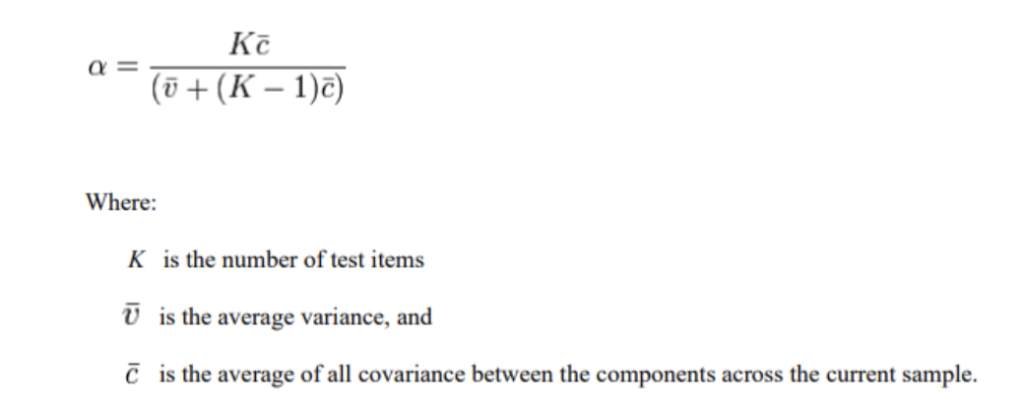
Research instrument’s reliability means the extent to which consistency and similarity in results could be achieved by a research instrument after several trials have been made (Mugenda and Mugenda, 2003). The researcher adopted the test-retest method, where the questionnaires were presented twice to the employees of the commercial banks selected within an interval of 7 days after the first presentation. The researcher believed that a 7-day interval could be long enough, hence the respondents would not be able to remember how they responded in the first round of the survey. In cases where the results would not be consistent, the test would assist in identifying the errors that are likely to result from the changes in time, and thus allow the researcher to set the questions and concepts appropriately. Cronbach’s reliability coefficient came in handy in estimating the research instrument’s internal consistency. Cronbach’s Alpha revealed how the scores from the two commercial bank employees were positively correlated. A score of +1 is considered a higher level of reliability, while +0.7 to +0.9 is within the acceptable range. This was calculated as follows:
3.7 Data Collection Procedures
The researcher requested an introductory letter from the university, through the School of Business, before the commencement of the study to leverage familiarity between the researcher and employees of commercial banks, and also guarantee the authenticity of the study. Data collection focused on two levels of observation. One is employee level because the analysis of employee’ satisfaction would require questioning each employee about their job satisfaction. The other level would be the company level, which would imply an investigation of the organizational performance. The logic of this employee variable-organizational variable is based on the principle that the job satisfaction of each employee affects the organizational performance. Questionnaires were presented to the heads of various departments, who, in turn, distributed them to the selected staff within the branches. To eliminate any element of mistrust and suspicion by the respondents, the researchers introduced the research topic through a letter, which was presented together with the questionnaires. The cover letter explained how the confidentiality and anonymity of the respondents would be ensured.
The data collected was cross-checked to confirm its consistency, completeness, and reliability. The responses were then coded in the coding sheets by transcribing the data from the questionnaires. Specifically, this involved assigning character symbols (numerical symbols). In addition, to minimize errors, data screening and cleaning were done. After that, the data were entered into SPSS for analysis.
3.8 Data Analysis and Presentation
The data collected was transferred to IBM SPSS 20 for automated examination. Descriptive statistics such as percentages, tabulations, frequencies, proportions, and cross-tabulations of key survey variables were generated. Categorical variables were examined for frequency, proportions, and counts, while numerical data were evaluated for measures of central tendency. To explore the relationship between independent and dependent variables, the study utilized inferential statistics, multiple regression analysis, and a correlation matrix. Regression equation Y=a+bX where Y=Organizational performance X=Employee Satisfaction and a and b is Y-intercept and Slope of the line respectively (constants) was used.
The thematic framework was deployed to analyze qualitative data. Thematic analysis is a qualitative analysis technique that identifies, analyzes and reports patterns or themes within data. According to researchers, the thematic framework has both advantages and limitations. Braun and Clarke (2006) argued that the thematic framework helps organize and describe data in rich detail, and it is not based on an epistemological and theoretical framework. This makes it flexible and widens its scope of application in qualitative research, while Boyatzis (1998) opined that the approach helps interpret various aspects of research. According to Attride-Stirling (2001), thematic analysis helps in identifying the relevant themes in a text at different levels, while thematic networks aim to assist in the structuring and depiction of the themes identified. Boyatzis (1998) corroborated Braun and Clarke (2006) that the thematic framework should be used as a tool for enhancing other methods, rather than being specifically considered a method of analysis. The research followed the principles of thematic analysis in analyzing and presenting qualitative data. Quantitative data was presented by the use of tables, pie-charts, and graphs.
3.9 Ethical Considerations
The respondents were taken through the proper consenting process by explaining to them what the study was all about, the advantages of participating, and assuring them that the confidentiality and anonymity of the information that they gave would be kept, and would only serve the sole interest of the study objectives. The respondents were also briefed about the voluntary nature of the study regarding participation. The researcher sought the authority of the Managers of the selected banks to allow their staff to be involved in the study. No research participant was paid or given other forms of incentives to take part in the research. They were given a sufficient amount of time to interact with research questions and room to answer questions that they wished to answer.
CHAPTER FOUR: FINDINGS AND DISCUSSIONS
4.1 Introduction
Chapter four presents and elaborates on the findings of the data collected from a sample of 400 employees of the sampled commercial bank branches across Nairobi County, based on the objectives of the study. Specifically, the chapter will reveal and discuss the background of the study respondents, response rate, and descriptive and inferential statistics.
4.2 Reliability Analysis
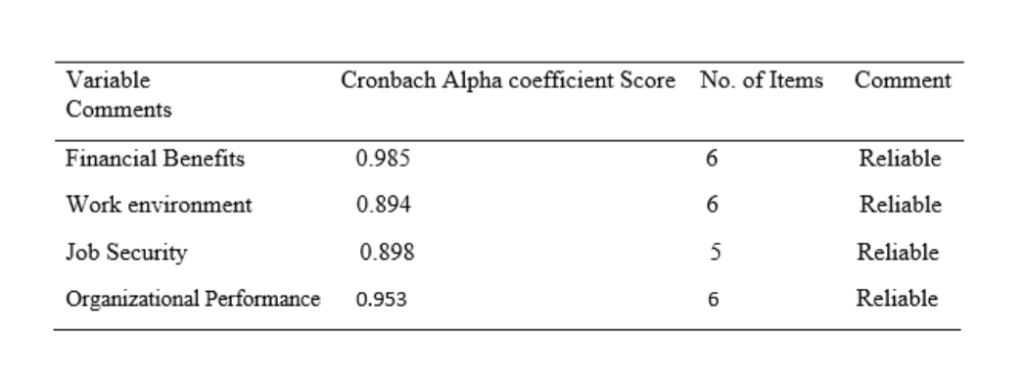
The researcher adopted the test-retest method, whereby the questionnaires were presented to a randomly selected 10 employees of the selected commercial banks in Nairobi County within an interval of 7 days after the first presentation. The Cronbach alpha methodology was used to measure the internal consistency of the data collection tool and the findings generated and presented in Table 4.2 below. As indicated in the table, Financial Benefits had a Cronbach alpha coefficient of 0.985; Work environment 0.894; Job Security 0.898, and Organizational Performance 0.953. According to the Cronbach alpha methodology, a score of +1 is considered a higher level of reliability, while +0.7 to +0.9 is within the acceptable range. The Cronbach alpha values exceeded 0.7, hence the tools were considered reliable.
Table 4.2: Reliability Analysis
Source: Author (2021)
4.3 Response rate for the questionnaires
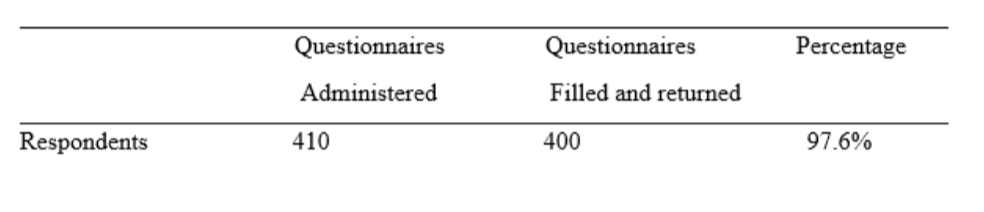
The researcher administered questionnaires to a sample of 410 employees of the selected commercial banks. Out of the 410 employees, 400 filled in and returned the questionnaires, translating to a 97.6% response rate as shown in Table 4.3 below.
Table 4.3: Response rate for the Questionnaires
Source: Author (2021)
4.4.1 Gender Distribution
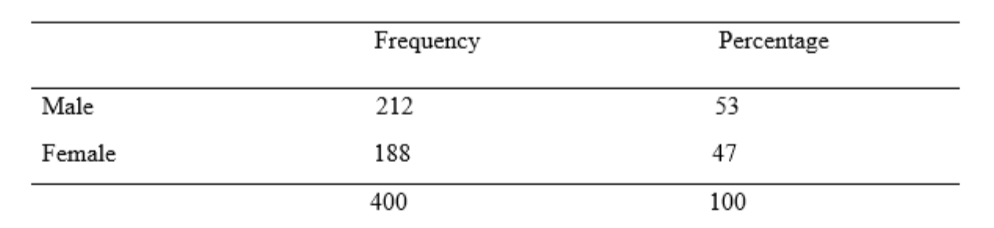
The respondents of the study were 212 (53%) males and 188 (47%) females, as shown in Table 4.4.1 below.
Table 4.4.1 Gender Distribution
Source: Author (2021)
4.4.2 Age Distribution
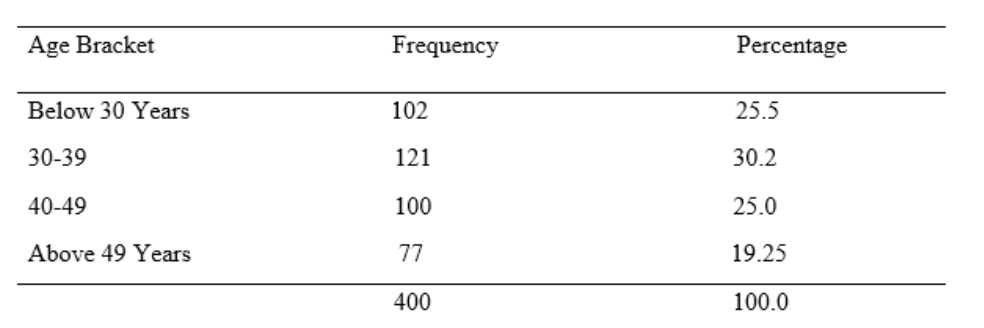
According to Table 4.4.2, a majority of the respondents (30.2%) were aged between 30-39 years. Those aged below 30 years accounted for 25.5% followed closely by respondents aged 40-49 years at 25.0%. The remaining respondents (above 49 years) accounted for 19.25%. It is evident that employees across selected commercial banks in Nairobi are mostly in their youth and could still be more energetic to deliver
Table 4.4:2 Age Distribution
Source: Author (2021)
4.4.3 Duration of service
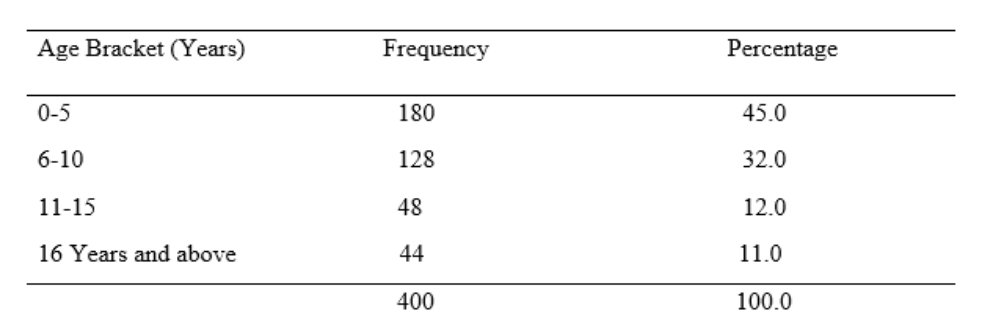
The findings of the study revealed that a majority (45.0%) of the respondents had worked with the selected commercial banks for 0-5 years; 32.0% had worked for 6-10 years; 12.0% had worked for 11-15 years, and 11.0% had worked with the selected commercial banks for over 16 years.
Table 4.4:3 Duration of service
4.4.4 Level of Education
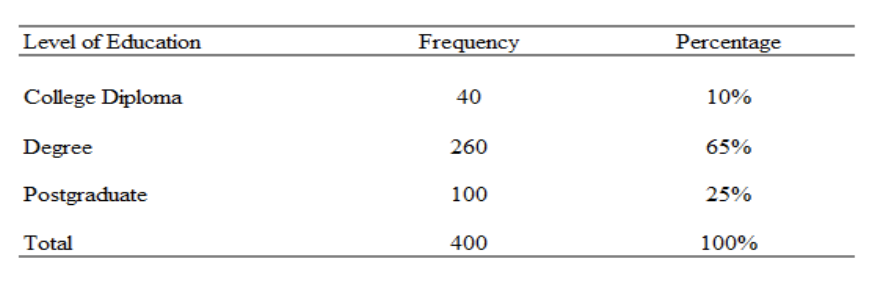
The findings of the study revealed that the Banking profession requires a high level of education, as the majority of the respondents (65%) had attained a Degree as their highest level of education. 25% had a postgraduate level of qualification, while the remaining 10% had a college Diploma. The findings are presented in Table 4.4.4 below.
Table 4.4.4 Level of Education
Source: Author (2021)
4.4.5 Nature of Employment
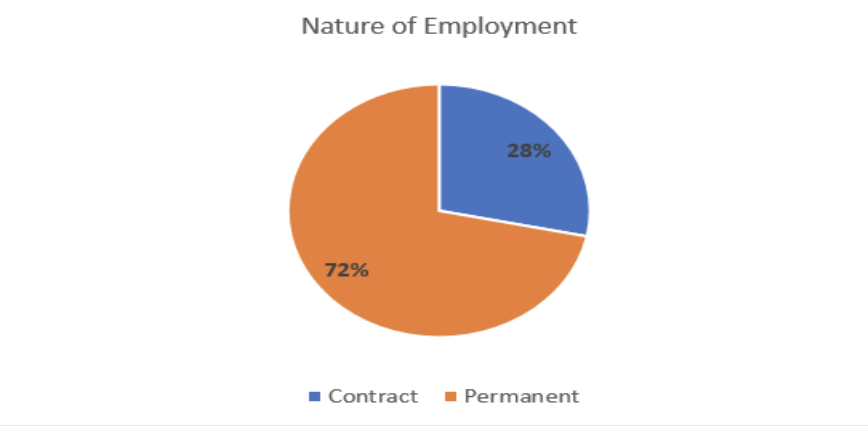
The study sought to understand the terms of agreement under which the respondents were working for the bank, and the findings revealed that 72% of the respondents were employed permanently, while 28% were employed on a contract basis, as shown in Table 4.4.5. This means that the majority of the bank employees are likely to work within their respective banking companies for a long time or throughout their professional life.
Figure 4.4.5 Nature of Employment
4.5 Descriptive findings and Discussions
This section presents descriptive findings regarding financial benefits, work environment, and job security, which are the dimensions of employee satisfaction. It also includes descriptive findings regarding organizational performance. The research study utilized descriptive statistics, including percentages and means.
4.5.1 Financial Benefits
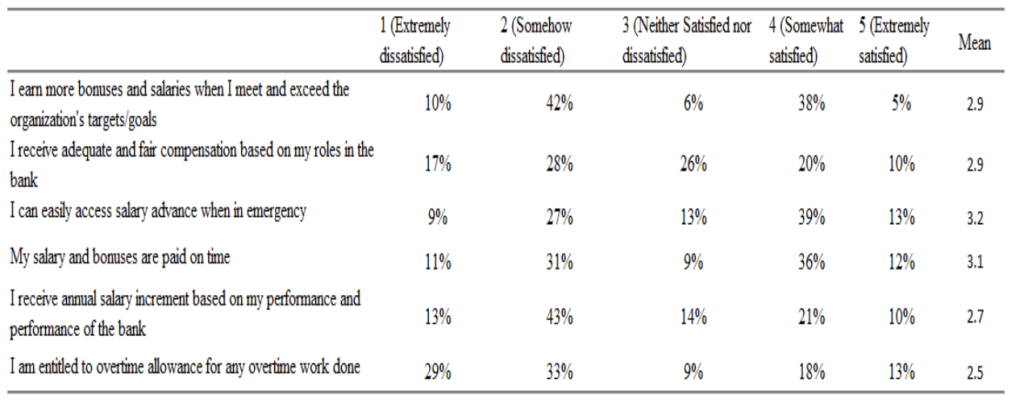
According to Table 4.5.1, most of the respondents (42%) felt somewhat dissatisfied, hence disagreed with the statement I earn more bonuses and salaries when I meet and exceed the organization’s goals. However, the study registered 38% and 5% of the respondents who felt somewhat satisfied and extremely satisfied with the statement, respectively. The majority of the respondents also felt dissatisfied and disagreed with the following statements: I receive adequate and fair compensation based on my roles in the bank (28%), I receive annual salary increment based on my performance and performance of the bank (43%), and I am entitled to overtime allowance for any overtime work done (33%). On the other hand, the majority of the respondents felt somewhat satisfied and agreed to the following statements: I can easily access a salary advance when in an emergency (39%), my salary and bonuses are paid on time. Generally, it is evident that most of the employees felt somewhat dissatisfied across most of the financial benefit variables, as reflected in the mean.
Table 4.5.1 Descriptive Statistics for Financial Benefits
4.5.2 Work Environment
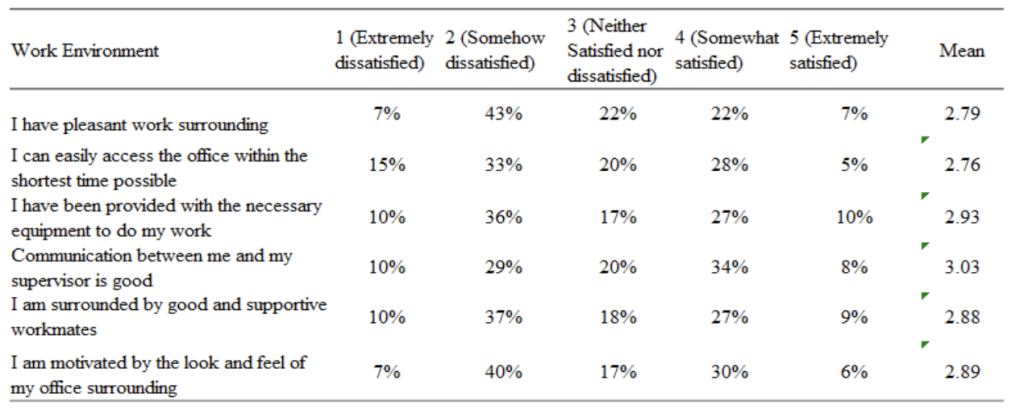
According to table 4.5.2 most of the respondents felt somehow dissatisfied hence disagreed with the statement; I have a pleasant work surrounding (43%), I can easily access the office within the shortest time (33%), I have been provided with the necessary equipment to do my work (36%), I am surrounded by good and supportive workmates (37%) and I am motivated by the look and feel of my office surrounding (40%). However, the majority of the respondents (34%) felt somewhat satisfied with the statement that communication between my supervisor and me is good. Few cases were recorded in which the respondents felt extremely satisfied and extremely dissatisfied with their work environment. Overall, most of the respondents reported being somewhat dissatisfied with their banking environments
Table 4.5.2 Descriptive Statistics for Work Environment
4.5.3 Job Security
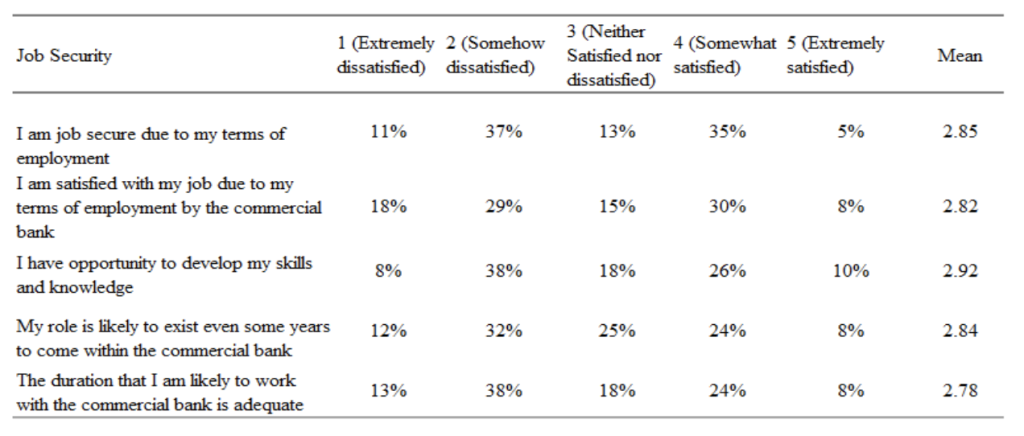
According to Table 4.5.3, nearly equal proportions of the respondents were somewhat satisfied and somewhat dissatisfied with the statement I am job secure due to my terms of employment at 35% and 37% respectively. Also, nearly an equal proportion of the respondents felt somewhat dissatisfied (29%) and somewhat satisfied (30%) with the statement I am satisfied with my job due to my terms of employment by the commercial bank. Most of the respondents felt somewhat dissatisfied, hence disagreed with the statement; I have the opportunity to develop my skills and knowledge (38%), my role is likely to exist even many years to come within the commercial bank (32%,) and the duration that I am likely to work with the commercial bank is adequate (38%). Most of the respondents who felt somewhat satisfied, and extremely satisfied with their job at the commercial ban,k were those in permanent employment.
Table 4.5.3 Descriptive Statistics for Job Security
4.5.4 Organizational performance
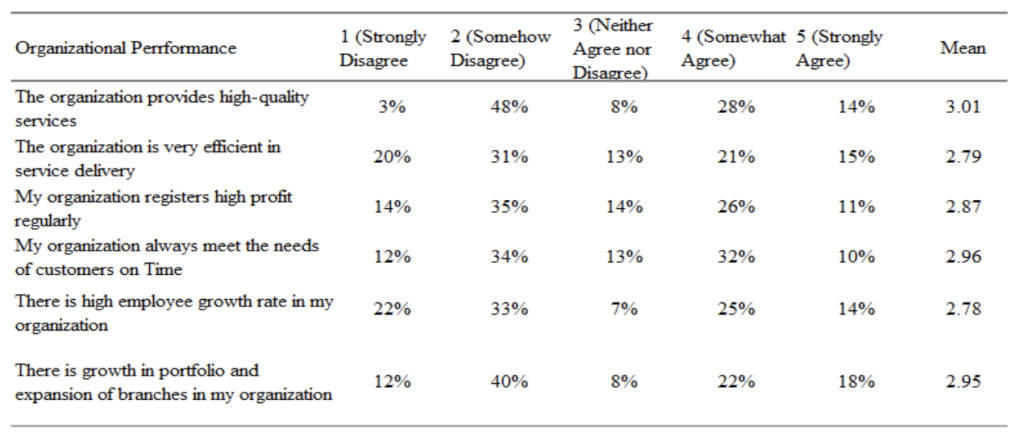
According to Table 4.5.4, most of the respondents (48%) somewhat disagreed with the statement that the organization provides high-quality services, followed by 28% who Somewhat Agreed with the statement. 14% of the respondents Strongly Agreed that their organization provides high-quality services. When asked about efficiency, most of the respondents (35%) disagreed, and 14% Strongly Disagreed that their organizations are very efficient in service delivery. Most of the respondents still disagreed with the statements: My organization always meets the needs of customers on time (34%), There is a high employee growth rate in my organization (33%), and There is growth in portfolio and expansion of branches in my organization (40%). However, there are some respondents who strongly agreed that their organizations are doing well across various performance variables listed in the table.
Table 4.5.4 Descriptive Statistics for Organizational Performance
4.6 Inferential findings and Discussions
The relationship between the independent variables and the dependent variable of the study is analyzed in this section. This research study utilized the Pearson correlation coefficient, ANOVA, and Multiple regressions to establish the existing relationship between the independent variables and the dependent variable. The independent variables analyzed are Financial Benefits, Work Environment, and Job Security. The dependent variable for the study is organizational performance (performance of the commercial banks)
4.6.1 Relationship between Financial Benefits and Organizational Performance
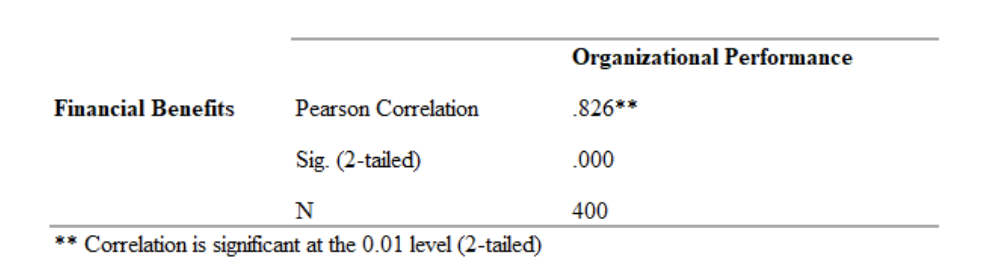
To find out the degree of influence of financial benefits on commercial banks’ performance, the study utilized Pearson Correlation to analyze the relationship between financial benefits and organizational performance. Table 4.6.1 shows that there is a strong positive correlation of 0.826 between Financial Benefits and Performance of the commercial Banks. The correlation is significant since p<0.01. This is an indication that financial benefits such as salary, overtime, and bonuses greatly influence the performance of the commercial banks.
Table 4.6.1 Relationship between Financial Benefits and Organizational Performance
4.6.2 Relationship between Work Environment and Organizational Performance
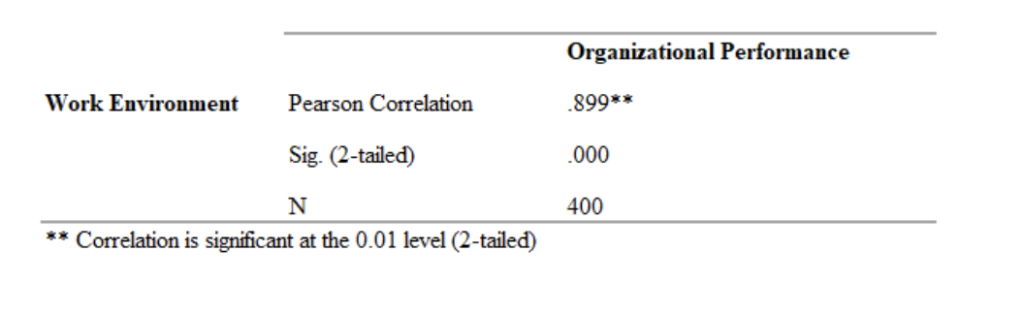
To establish the level and direction of the influence of the work environment on commercial banks’ performance, the study utilized Pearson Correlation to analyze the relationship between Work Environment and organizational performance. Table 4.6.2 shows that there is a strong positive correlation of 0.899 between Work Environment and Performance of the commercial Banks. The correlation is significant since p<0.01. This is an indication that employee work environment, such as availability of working equipment, employee relations, and office location, greatly influence the performance of the commercial banks.
Table 4.6.2 Relationship between Work Environment and Organizational Performance
4.6.3 Relationship between Job Security and Organizational Performance
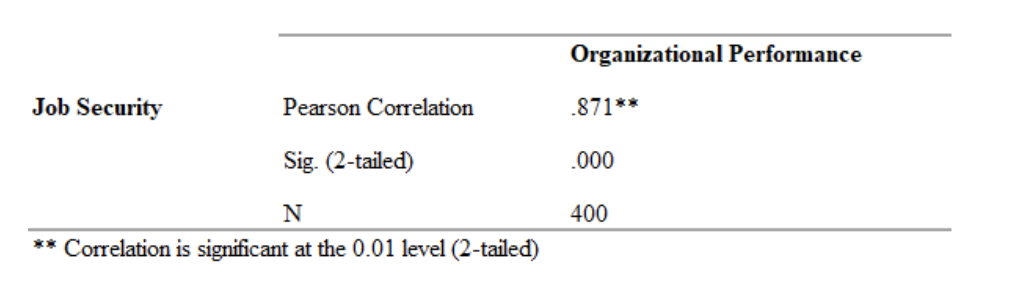
To establish the effects of job security on commercial banks’ performance, the study utilized Pearson Correlation to analyze the relationship between Job Security and organizational performance. Table 4.6.3 shows that there is a strong positive correlation of 0.871 between Job Security and Performance of the commercial Banks. The correlation is significant since p<0.01. This is an indication that Job security, such as the type of work, nature of employment, and type of work, greatly influences the performance of the commercial banks.
Table 4.6.3 Relationship between Job Security and Organizational Performance
4.6.4 Model Summary
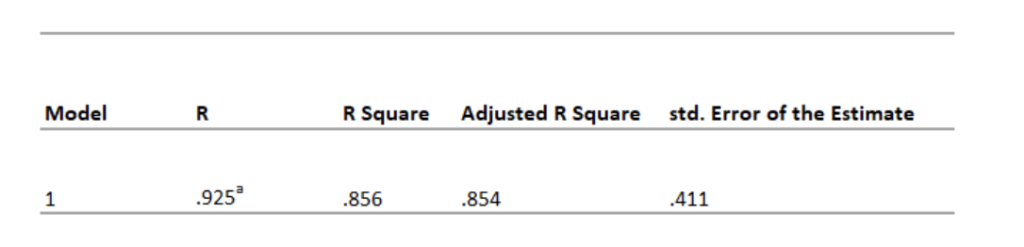
Multiple regression analysis was used in the study to test the influence of the independent variables. The results of the analysis are presented in table 4.6.4 below
Table 4.6.4a Model summary
Source: Author (2021)
a. Predictors: (Constant), Financial Benefits, Work Environment, and Job Security
According to Table 4.6.4b, the predictors in the model have a strong positive correlation (R .925) with the dependent variable. The coefficient of determination (r2= .856) indicates that 85.6% of commercial banks' performance can be attributed to the three dimensions of job satisfaction: financial benefits, work environment, and job security. The adjusted R-squared (.854) implies that 85.4% variation in the model can be explained by the independent variables that only affect organization performance.
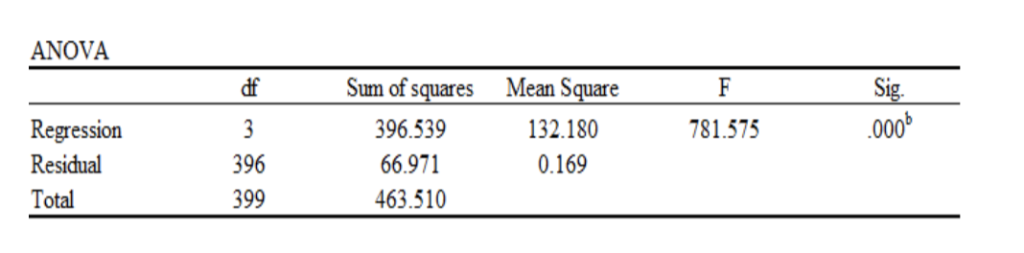
Table 4.6.4b Summary of ANOVA results
a. Dependent Variable: Organizational Performance
b. Predictors: (Constant), Financial Benefits, Work Environment, and Job Security
As presented in Table 4.6.4b, Analysis of Variance (ANOVA) results reveal that financial benefits, work environment, and job security have a significant association with organizational performance since the p-value (.000) is less than the level of significance (0.05)
Table 4.6.4c Coefficientsa
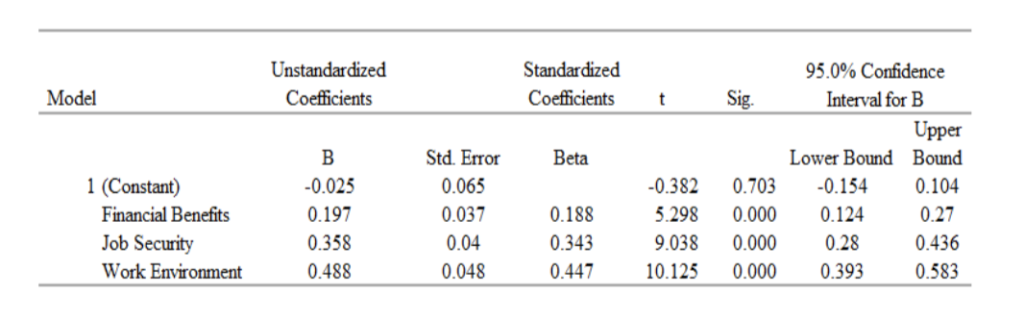
Source: Author (2021)
Dependent Variable: Performance of the commercial banks
The results of the multiple regression analysis are illustrated in Table 4.6.4.c and are guided by the model:
Y= β0 + β1X1+ β2X2+ β3X3 +ε
Where:
Y represents the performance of the commercial banks
β0 represents Constant
X1 represents Financial Benefits
X2 represents the work Environment
X3 represents Job Security
β1,β2, β3 represent the regression coefficients
ε represents ErrorTerm
From the regression equation established, taking all the factors (Financial Benefits, Work Environment, and Job Security) constant at zero, the performance of the commercial banks would be at -0.025. If other factors are kept constant, a unit increase in financial benefits will lead to a 0.197 increase in commercial bank performance. A unit increase in job security will lead to a 0.358 increase in commercial bank performance, while a unit increase in work environment will lead to a 0.488 increase in commercial bank performance. Financial Benefits, Work Environment, and Job Security are significant in the model since p-value .000 is less than .05 alpha. According to Vakola and Nikolaou (2005) Interpersonal Relations which is part of work environment and effective reward system including financial benefits can be a significant factor in organizational success. They observed that when employees are satisfied, their productivity is likely to improve, which in turn would improve organizational performance.
Vakola & Nikolaou (2005) noted that Interpersonal Relations and effective reward systems can be a significant factor in organizational success. But a dissatisfied workforce can negatively disrupt an organization and distract employees from their work, affecting organizational performance.
4.6.5 Correlation Analysis Matrix
|
Table 4.6.5 Correlation Analysis Matrix | |||||
|
Organizational Performance |
Financial Benefits |
Job Security |
Work Environment | ||
|
Pearson Correlation |
Organizational Performance |
1.000 |
.826 |
.871 |
.899 |
|
Financial Benefits |
.826 |
1.000 |
.770 |
.836 | |
|
Job Security |
.871 |
.770 |
1.000 |
.859 | |
|
Work Environment |
.899 |
.836 |
.859 |
1.000 | |
|
Sig. (1-tailed) |
Organizational Performance |
. |
.000 |
.000 |
.000 |
|
Financial Benefits |
.000 |
. |
.000 |
.000 | |
|
Job Security |
.000 |
.000 |
. |
.000 | |
|
Work Environment |
.000 |
.000 |
.000 |
. | |
Source, Author 2021
Table 4.6.5 above indicates that there is a strong positive correlation between Financial Benefits (r=0.826), Job Security (0.871), and Work Environment (0.899) with Organizational Performance which was statistically significant at α=1%, with a P=value of 0.000
SUMMARY OF FINDINGS, CONCLUSION, AND RECOMMENDATIONS
5.1 Introduction
This chapter summarizes key descriptive and inferential findings from the study, presents the conclusion, and recommendations.
5.2 Summary of findings
This section presents summarized descriptive and inferential findings of the study.
4.5.1 Financial Benefits and Organizational Performance
Most of the respondents disagreed with the statements; I earn more bonuses and salaries when I meet and exceed the organization’s goals, I receive adequate and fair compensation based on my roles in the bank, I receive annual salary increment based on my performance and performance of the bank, and I am entitled to overtime allowance. On the other hand, the majority of the respondents felt somewhat satisfied and agreed to the following statements: I can easily access a salary advance in an emergency, my salary and bonuses are paid on time. Overall, a majority of the respondents felt dissatisfied with financial benefits offered by the commercial banks. Further analysis revealed that there is a strong positive correlation of 0.826 between Financial Benefits and Performance of the commercial Banks. The correlation is significant at p<0.01. This is an indication that financial benefits such as salary, overtime, and bonuses greatly influence the performance of the commercial banks, and therefore, poor performance of the commercial banks can be attributed to the rewards and remuneration system adopted.
4.5.2 Work Environment and Organizational Performance
Most of the respondents felt that they had not been provided with a pleasant work environment, they could not access the offices more conveniently/easily, they had not been provided with the necessary equipment to do their job, and there were poor interpersonal relations among colleagues. However, most of the respondents agreed that they have a good relationship with their supervisors. Inferential analysis established that there is a strong positive correlation of 0.899 between Work Environment and Performance of the commercial Banks. The correlation is significant since p<0.01. This is an indication that employee work environment, such as availability of working equipment, employee relations, and office location, greatly influence the performance of the commercial banks.
4.5.3 Job Security
Nearly equal proportion of the respondents were somewhat satisfied and somewhat dissatisfied with the statement I am job secure due to my terms of employment. Similarly, an equal proportion of the respondents felt somewhat dissatisfied and somewhat satisfied with the statement I am satisfied with my job due to my terms of employment by the commercial bank. Most of the respondents felt somewhat dissatisfied, hence disagreed with the statement; I have the opportunity to develop my skills and knowledge, my role is likely to exist for many years to come within the commercial bank, and the duration that I am likely to work with the commercial bank is adequate. Most of the respondents who felt somewhat satisfied and extremely satisfied with their job at the commercial bank, were those in permanent employment. Further analysis shows that there is a strong positive correlation of 0.871 between Job Security and Performance of the commercial Banks. The correlation is significant since p<0.01. This is an indication that Job security, such as the type of work, nature of employment, and type of work, greatly influences the performance of the commercial banks.
4.5.4 Organizational performance
Most employees of the commercial banks disagreed with the statements that my organization provides high-quality service, my organization is efficient in service delivery, my organization always meets the needs of customers on time, there is a high employee growth rate in my organization, and there is growth in portfolio and expansion of branches in my organization. However, there are some respondents who strongly agreed that their organizations are doing well across various performance variables listed in the table.
5.2 Conclusion
In this section, the research study presents the conclusions drawn from both descriptive and inferential statistics based on the research questions and hypotheses.
5.2.1 Influence of Financial Benefits on Organizational Performance
Based on the research findings, it was concluded that financial benefits such as salary, bonuses, and overtime pay affect organizational performance. Similarly, a study conducted by Aryan & Singh (2015) in Haryana and Punjab, India, to investigate the impact of recognition and motivation on employees’ performance in private and public banks, it was proven that employees’ performance is greatly influenced by factors like salary and other monetary and non-monetary benefits that the organization provides. Incentives and other financial rewards provided by the organization significantly affect employees’ job performance, which eventually influences organizational performance.
5.2.2 Influence of Work Environment on Organizational Performance
It was concluded that the work environment affects organizational performance. The study considered employee interrelations, the office environment, and location, and the availability of working equipment as a description of the work environment. Leblebici (2012) indicated that employees’ productivity and organizational performance thrive well in a work environment where employees feel comfortable and motivated due to good working conditions. Organizations with healthy physical work conditions tend to have a competitive edge over others. It has been revealed that improving the work environment reduces complaints and absenteeism among employees and, at the same time, increases productivity (Roelofsen, 2007). A study done by Chevalier (2004) indicates that “when environmental supports are sound, employees are better equipped to do what is expected of them”. This is supported by Chandrasekar 2003 that the work environment plays a big role in increasing employee performance. Hameed & Amjad (2009) surveyed a total of 31 branches of the commercial banks and found that employees are more motivated when they work under a comfortable and ergonomic office design. As such, their level of performance increases in such work conditions.
5.2.3 Influence of Job Security on Organizational Performance
The study established a strong and significant connection between job security and organizational performance. Job security included the duration/nature of the employment contract, the nature, and the type of job. Most employees of the commercial banks who were on permanent contracts felt more secure than those who were working on short contracts.
James (2012) indicated that job security significantly impacts the overall organizational performance. He observed that organizations that don’t guarantee job security to their employees experience low morale among employees due to loss of faith, consequently affecting the performance of the organizations. He asserts that “the more an employee enjoys high job security, the more he is likely to effectively perform his task”. This consequently impacts the overall performance of an organization. However, research conducted by Subramaniani et al. (2011) that linked organizational performance and human resource practices in small and medium firms (SMEs) in Malaysia, revealed that job security is less significantly related to organizational performance
5.2.4 Organizational performance
Most employees of the commercial banks disagreed with the statements that my organization provides high-quality service, my organization is efficient in service delivery, my organization always meets the needs of customers on time, there is a high employee growth rate in my organization, and there is growth in portfolio and expansion of branches in my organization. However, there are some respondents who strongly agreed that their organizations are doing well across various performance variables listed in the table.
5.3 Recommendations
The following recommendations have been made based on the study findings:
Adopting motivating and market rate economic reward system: Workload within the banking sector is always demanding. Most of the time, employees work overtime to meet the strict deadlines. To improve performance, the study recommends that Managers and the Human Resource team should budget for and regularly review financial benefits available for employees so that the employees can be rewarded based on their work and performance. Employees should be motivated by bonuses when they exceed their targets or when they demonstrate exemplary performance. Organizations should also consider factoring in overtime allowances in their budgets to motivate employees who are willing to deliver on odd business hours including weekends.
Providing a conducive work environment: Workplace is the second home of most of the employees since this is where they spend most of their time, the entire week. Therefore, the Human Resource team should ensure that it sets up conflict management structures as a way of investigating issues of interpersonal relations and resolving conflicts. Organizations should also set aside an adequate budget to purchase equipment for doing the job, such as functional computers and printers. Employees should also be provided with ergonomically designed chairs to enable them to sit upright and more comfortably while delivering. Human Resource Managers should also ensure that the workplace environment is inclusive to accommodate employees living with disabilities by improving accessibility to the office, improving toilet facilities, and facilitating employees with disabilities to access assistive devices. Other inclusive facilities that the organizations should consider putting in place include lactating rooms for mothers with young babies.
Assuring the employees of their job security: Employees with longer contractual or permanent contractual agreements tend to have peace of mind, hence are more satisfied than employees who are working on short-term contracts. Organizations should assure employees of their job security by offering them permanent or open contracts. Otherwise, the employers should explain to employees the available opportunities in the future and if there is a possibility of long-term engagement.
5.4 Suggestion for further research
The research relied on operational performance indicators of the commercial banks’ performance, such as employee growth, quality of service delivery, customer satisfaction, and employee commitment, to understand how they relate to employee satisfaction variables such as financial benefits, work environment, and job security. However, the study suggests that there is a need for further research on the relationship between job satisfaction and organizational performance of the commercial banks using various financial indicators of performan,ce such as Return on Investment, Return on Assets
I am …………. a Master of Business Administration degree student from …….. University. I am seeking information on employee satisfaction effects on the performance of selected commercial banks in Nairobi City County, Kenya. The purpose of the study will be to examine employee satisfaction effects on the performance of commercial banks in Nairobi City County Kenya. The findings of the study will be useful insights for Bank and HR Managers on the major factors that determine employee satisfaction and performance and recommendations for improvements in order to remain competitive in the sector. The survey will take you 10-15 min hence I will appreciate your participation in this research. Any responses that we will gather from you will remain confidential and your name will never be used in connection with any of the information you give but may be used in case of need to come back to you to clarify any information and be assured that your responses will be destroyed at the end of the data collection once the information has been covered. However, your participation in the study will be voluntary. There is no foreseeable risk associated with this study since it will be meant for academic purposes. Therefore, if you will be interested to follow-up on the findings of the study, you can reach me through my email addres XXXX.
I agree to participate in this study.
Signature of the interviewee----------------------------- Date------/------/2020
APPENDIX 2: QUESTIONNAIRE TO THE RESPONDENTS
This questionnaire seeks information on employee satisfaction effects on the performance of selected Commercial Banks in Nairobi City County, Kenya. You are kindly requested to complete this questionnaire by filling in the blanks either with a tick [√] or words against the most appropriate answer
SECTION A: Demographic details:
Fill or put a tick in the boxes provided
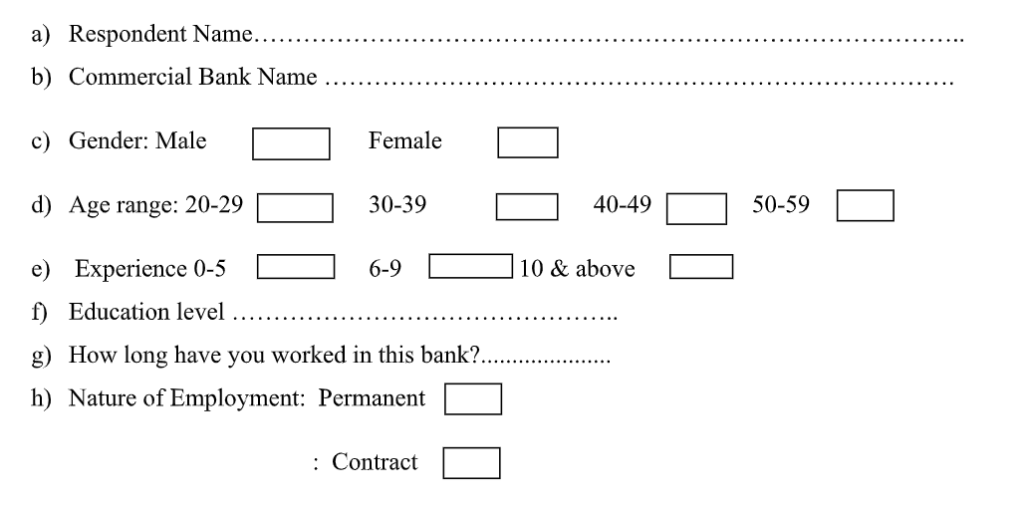
SECTION B: Financial benefit
Kindly indicate your level of satisfaction based on the following financial benefit variables by marking with a tick most appropriately. Under items, the column includes a list of statements and on the right includes columns where
1= Extremely dissatisfied, 2=Somehow dissatisfied, 3=Neither Satisfied nor dissatisfied, 4= Somewhat satisfied 5=Extremely satisfied
|
Items |
1 |
2 |
3 |
4 |
5 |
|
I earn more bonuses and salaries when I meet and exceed the organization’s targets/goals | |||||
|
I receive adequate and fair compensation based on my roles in the bank | |||||
|
I can easily access salary advance when in emergency | |||||
|
My salary and bonuses are paid on time | |||||
|
I receive annual salary increment based on my performance and performance of the bank | |||||
|
I am entitled to overtime allowance for any overtime work done |
SECTION C: Work environment
Kindly indicate your level of satisfaction based on the following work environment variables marking with a tick most appropriately. Under items, the column includes a list of statements and on the right includes columns where
1= Extremely dissatisfied, 2=Somehow dissatisfied, 3=Neither Satisfied nor dissatisfied, 4= Somewhat satisfied 5=Extremely satisfied
|
Items |
1 |
2 |
3 |
4 |
5 |
|
I have pleasant work surrounding | |||||
|
I can easily access the office within the shortest time possible | |||||
|
I have been provided with the necessary equipment to do my work | |||||
|
Communication between me and my supervisor is good | |||||
|
I am surrounded by good and supportive workmates | |||||
|
I am motivated by the look and feel of my office surrounding |
SECTION D: Job Security
Kindly indicate your level of satisfaction on job security variables marking with a tick most appropriately. Under items, the column includes a list of statements and on the right includes columns where
1= Extremely dissatisfied, 2=Somehow dissatisfied, 3=Neither Satisfied nor dissatisfied, 4= Somewhat satisfied 5=Extremely satisfied
|
Items |
1 |
2 |
3 |
4 |
5 |
|
I am job secure due to my terms of employment | |||||
|
I am satisfied with my job due to my terms of employment by the commercial bank | |||||
|
I have opportunity to develop my skills and knowledge | |||||
|
My role is likely to exist even some years to come within the commercial bank | |||||
|
The duration that I am likely to work with the commercial bank is adequate |
Section E: Commercial Banks Performance
Kindly indicate your level of agreement with the statements below by marking with a tick most appropriately. Under items column includes a list of statements and on the right includes columns where
1=Strongly Disagree, 2=Disagree, 3=Neither agree nor Disagree 4=Agree, 5=Strongly Agree
|
Items |
1 |
2 |
3 |
4 |
5 |
|
The organization provides high-quality services | |||||
|
The organization is very efficient in service delivery | |||||
|
My organization registers high profit regularly | |||||
|
My organization always meet the needs of customers on Time | |||||
|
There is high employee growth rate in my organization | |||||
|
There is growth in portfolio and expansion of branches in my organization |
APPENDIX 3: PROJECT TIME PLAN
|
Activities in the Year 2020 |
Jan |
Feb |
Mar |
Nov |
|
Proposal Writing | ||||
|
Defense | ||||
|
Piloting & Revision of the tools | ||||
|
Data Collection | ||||
|
Data Analysis & Reporting |
|
Stationary |
Units |
Unit Cost |
Total Cost | |
|
Pen |
8 |
50 |
400 | |
|
Notebook |
1 |
500 |
500 | |
|
Browsing |
No. of months |
Monthly subscription |
Total Cost | |
|
Internet |
4 |
2000 |
8000 | |
|
Typesetting & Print |
No. of Pages |
Cost per page |
Total Cost | |
|
Proposal Typesetting |
40 |
25 |
1000 | |
|
Proposal Printing |
40 |
10 |
400 | |
|
Typesetting & Printing Questionnaires |
384 |
10 |
3840 | |
|
Subtotal |
5240 | |||
|
Data Collection |
Pax |
Daily Rate |
No. of Days |
Tot. Cost |
|
Enumerator |
2 |
1500 |
5 |
15000 |
|
Enumerators Travel (bank-bank) |
2 |
500 |
5 |
5000 |
|
Subtotal |
20000 | |||
|
Data Analysis |
15000 | |||
|
Printing & Compiling Report |
No. of Copies |
Unit cost per copy |
Total Cost | |
|
Report |
3 |
500 |
1500 | |
|
Contingencies |
Calculated 10 Percent of the Tot. Cost |
5064 | ||
|
Total Cost |
55704 | |||
APPENDIX 5: LIST OF COMMERCIAL BANKS IN KENYA
|
No. |
Commercial Bank |
|
1 |
ABC Bank Kenya |
|
2 |
Bank of Africa |
|
3 |
Bank of Baroda |
|
4 |
Bank of India |
|
5 |
Barclays Bank of Kenya |
|
6 |
Chase Bank Kenya |
|
7 |
Citibank |
|
8 |
Commercial Bank of Africa |
|
9 |
Consolidated Bank of Kenya |
|
10 |
Cooperative Bank of Kenya |
|
11 |
Credit Bank |
|
12 |
Development Bank of Kenya |
|
13 |
Diamond Trust Bank |
|
14 |
Dubai Islamic Bank |
|
15 |
Ecobank Kenya |
|
16 |
Equity Bank |
|
17 |
Family Bank |
|
18 |
First Community Bank |
|
19 |
Guaranty Trust Bank Kenya |
|
20 |
Guardian Bank |
|
21 |
Gulf African Bank |
|
22 |
Habib Bank AG Zurich |
|
23 |
Housing Finance Company of Kenya |
|
24 |
I&M Bank |
|
25 |
Imperial Bank Kenya |
|
26 |
Jamii Bora Bank |
|
27 |
Kenya Commercial Bank |
|
28 |
Mayfair Bank |
|
29 |
Middle East Bank Kenya |
|
30 |
National Bank of Kenya |
|
31 |
NIC Bank |
|
32 |
Oriental Commercial Bank |
|
33 |
Paramount Universal Bank |
|
34 |
Prime Bank (Kenya) |
|
35 |
SBM Bank Kenya Limited |
|
36 |
Sidian Bank |
|
37 |
Spire Bank |
|
38 |
Stanbic Bank Kenya |
|
39 |
Standard Chartered Kenya |
|
40 |
Trans National Bank Kenya |
|
41 |
United Bank for Africa |
|
42 |
Victoria Commercial Bank |
|
43 |
Giro Commercial Bank Ltd |
Source: Central Bank of Kenya (2016)
Offload drafts to field expert
Our writers can refine your work for better clarity, flow, and higher originality in 3+ hours.
Match with writerREFERENCES
- Abbas, Z. (2014). Identification of factors and their impact on employees' training and organizational performance in Pakistan. Kasbit Journal of Management & Social Science, 7(1), 93-109.
- Abe, I. and Mason, B. (2016). The role of individual interpersonal relationships on work performance in the South African retail sector. Problems and Perspectives in Management, Volume 14, Issue 2
- Adongo, J.A. (2013). Examining the effects of job training on employee performance in the mobile telephone industry. A case of Telkom Orange Nakuru, Kenya. Unpublished Master’s Thesis. Kenyatta University
- Agusioma, N. L. (2013). Influence of employee relations on organization performance of private universities in Kenya. International Journal of Innovative Research and Studies. Vol. 2, Issue, 8
- Ariani, D. (2015). Relationship with supervisor and co-workers, psychological condition and employee engagement in the workplace. Journal of Business and Management. Volume 4, Issue 3, 34-47
- Bahmanabadi, S. (2015). A case study of the impact of leadership styles on bank employees’ job satisfaction. Published Master’s thesis. Södertörn University, Sweden
- Balser, D., McClusky, J. (2005). Managing stakeholder relationships and nonprofit organization effectiveness. Nonprofit Management & Leadership, 15, 295-315.
- Brooks, J. (2014). A study of the relationship between job satisfaction and financial performance in Pennsylvania Community Banks. Published Ph.D. thesis. Indiana University of Pennsylvania
- Cameron, K. S, Whetton, D., & Kim, M. 1987. Organizational dysfunctions of decline. Academy of Management Journal, 30(1): 126-138.
- Central Bank of Kenya (n.d): Bank History; retrieved from https://www.centralbank.go.ke/bank-history/
- Connolly, T., Conlon, E. M., Deutsch, S. J. (1980). Organizational effectiveness: A multiple constituency approach. Academy of Management Review, 5, 211-218.
- Herman, R. D., Renz, D. O. (1997). Multiple constituencies and the social construction of nonprofit organization effectiveness. Nonprofit and Voluntary Sector Quarterly, 26, 185-206.
- Herman, R. D., Renz, D. O. (2008). Advancing nonprofit organizational effectiveness research and theory: Nine theses. Nonprofit Management & Leadership, 18, 399-414.
- Hofer, C. W. 1975. Toward a contingency theory of business strategy. Academy of Management Journal, 18(4): 784-811.
- Inuwa, M. (2016). Job satisfaction and employee performance. The Millennium University Journal; 1(1), p.18
- Islam, N.J. Mohajan, H.K. Datta, R. (2012). A study on job satisfaction and morale of commercial banks in Bangladesh.Int. J. Eco. Res., 2012, 153-173
- James, G. 2012. How to achieve true job security. http://www.inc.com/geoffrey-james/how-to-achieve-true-job-security.html
- Lee, H.J. (2011). Effects of workplace friendship on employee job satisfaction, Organizational Citizenship Behavior, Turnover Intention, Absenteeism, and Task Performance. Hospitality Management and Dietetics, Kansas State University
- Mitiku,A., Damte, M. and Bayissa, L. (2015) The Impact of Training and Development on Employee Performance and Effectiveness: A Case Study of District Five Administration Office, Bole Sub-City, Addis Ababa, Ethiopia. Journal of Human Resource and Sustainability Studies, 3, 188-202
- Mutsostso, S., & Wanyama, K. (2010) Relationship Between Capacity Building and Employee Productivity on Performance of Commercial Banks in Kenya, African Journal of History and Culture Vol. 2(5), pp 73-78.
- Nassazi, A. (2013) Effects of training on employee performance. Evidence from Uganda. Published Master's Thesis. Vaasan Ammattikorkeakoulu, University of Applied Sciences
- Odembo, S.A. (2014). Job satisfaction and employee performance within the Telecommunication industry in Kenya: A Case of Airtel Kenya Limited. Unpublished Master’s thesis. Kenyatta University
- Ogbulafor C. (2011). Motivation and job performance of the academic staff of state universities in Nigeria: the case of Ibrahim Badamasi Babangida University, Lapai, Niger State. International Journal of Business and Management, 7(14), p142.Rath, T. (2006). Vital friends. New York: Gallop Press.
- Raziq, A. (2015) Impact of Working Environment on Job Satisfaction. Procedia Economics and Finance. Volume 23, Pages 717-725
- Sabri, P., Amjad, Z., Muhammad, I. and Hameed, A. (2015) Informal Relationships at Workplace and Employee Performance: A Study of Employees Private Higher Education Sector. Pakistan Journal of Commerce and Social Sciences, Vol.9 (1), 303-321 Saiyadain, Mirza (2009). Human Resources Management. McGraw-Hill, Inc.
- Shah, F. and Athar, R. (2015) Impact of training on employee performance (Banking Sector Karachi). Journal of Business and Management: 17(11): Pp. 58-67
- Wu, M. Y., & Lee, Y. R. (2011). The effects of internal marketing, job satisfaction and service attitude on job performance among high-tech firm. African Journal of Business Management, 5(32), 12551-12562.
- APPENDIX 1: INTRODUCTION LETTER
- Introduction and consent
